

















Bullhorn is a cloud-based ATS and CRM built specifically for staffing and recruitment agencies, combining candidate sourcing, client relationship management, and placement tracking in one system of record.
- Primary Features: Applicant tracking and CRM, AI-powered search and match, Amplify AI (chat, screening, digital workers), recruitment automation and engagement, reporting and analytics.
- Starting Price: From $99 per user/month for Starter, up to $165 for Core, with the AI-powered Pro and Max tiers priced by custom quote.
- Best For: Mid-size to enterprise staffing and recruiting agencies operating full-desk workflows, plus small agencies (1-10 users) that want the same platform larger firms use.
- Not Ideal For: Solo recruiters or very small teams that want a self-serve tool with no sales call, agencies that need modern AI screening included at the entry price, or firms that want contingent workforce payroll bundled into their core subscription.
- Integration: Most staffing agencies integrate Skima AI with Bullhorn to screen new applicants, resurface past candidates who fit new openings, and score every match with clear, explainable reasoning, all without replacing Bullhorn or requiring data migration.
Bullhorn built its reputation as the go-to applicant tracking and CRM platform for staffing agencies. However, corporate in-house teams, specialized firms that don’t follow a full-desk model, and agencies that want AI-first screening often struggle with a system designed around someone else's workflow.
Our research team invested over 60 hours evaluating Bullhorn's features and AI. We reviewed verified user feedback and cross-checked every claim against the platform's current product. We also identified where Bullhorn shines and where staffing teams encounter genuine challenges or begin to consider integrations to fill the gaps.
What Is Bullhorn?
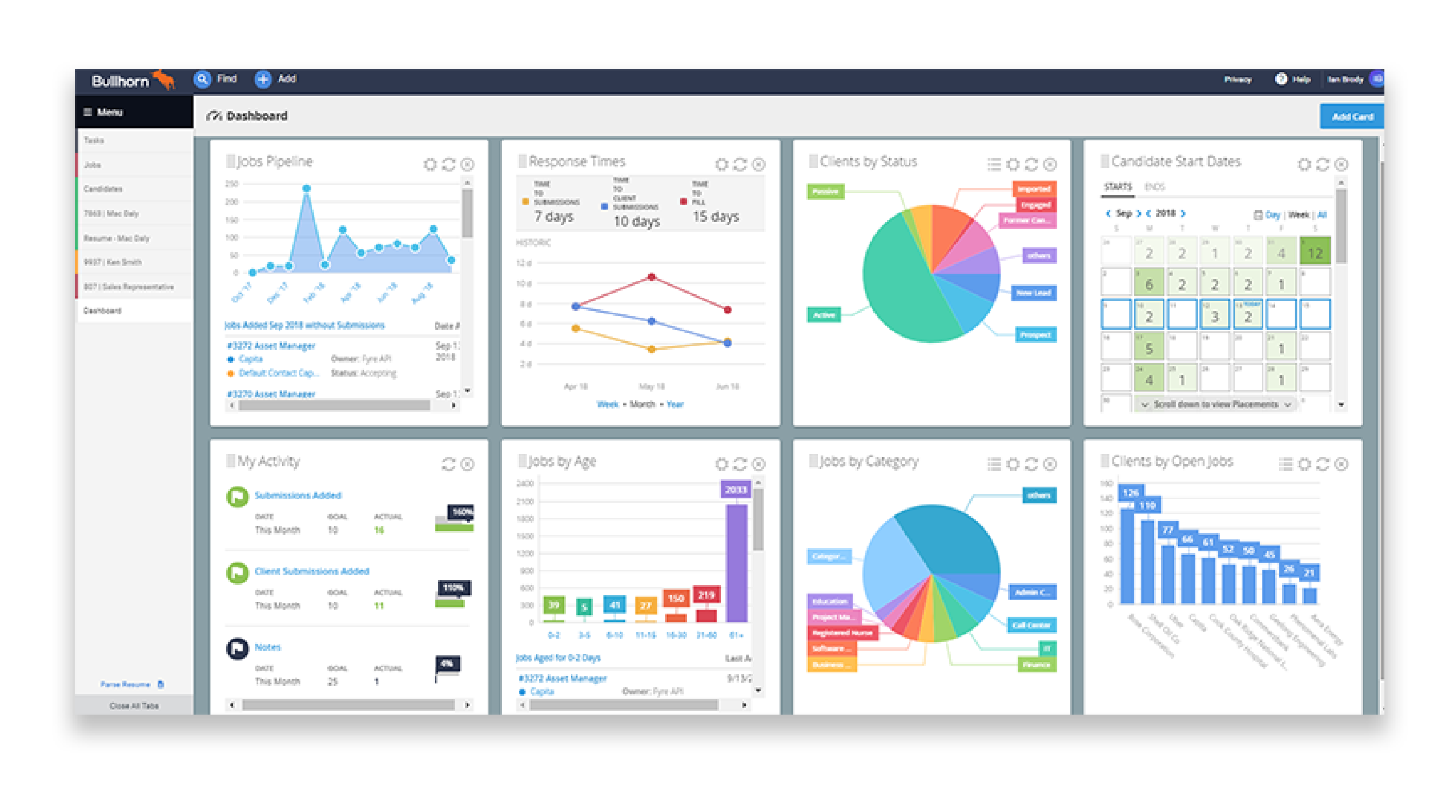
Bullhorn is a cloud-based applicant tracking system and CRM built specifically for staffing and recruitment agencies, combining candidate sourcing, client relationship management, and placement tracking in a single system of record.
Founder Art Papas still leads the company today, more than two decades after Bullhorn first launched as a platform for freelancers before shifting to recruitment-focused CRM software.
Bullhorn Features Review
Bullhorn combines the core ATS and CRM, Amplify (AI layer), workflow automation, and reporting. Below is our honest, feature-by-feature review of what each module does well and where it begins to show its limits:
Applicant Tracking & CRM
A recruiter's day mostly revolves around this one module. Candidate records, client accounts, job orders, and placements are all in the same searchable database. Notes, calls, and emails attach directly to a candidate or client record, so an account manager and a recruiter working the same client see identical history without switching tools.
Resume parsing automatically extracts contact details, skills, and work history upon upload. A mobile app handles basics like logging calls and reviewing candidates, but several users mention it falls short compared to the desktop experience in terms of depth.
Amplify AI: Chat and Screening
Amplify is Bullhorn's AI layer that handles screening and outreach within the familiar recruiter interface. Amplify Chat acts as an internal assistant, answering queries about candidates, jobs, and clients using the firm's Bullhorn data instead of the open internet.
Higher tiers offer agentic screening, where candidates respond to structured questions via voice or chat before recruiters review them, along with AI-generated resume summaries. Availability of these features varies by agency pricing tier.
Recruitment Automation & Engagement
Bullhorn Automation (formerly Herefish) manages the repetitive tasks in the recruiting cycle. This includes candidate nurture sequences, status update emails, data cleanup, and multi-step follow-ups that would otherwise rely on a recruiter's memory.
It also features a built-in NPS survey tool that companies use to gather candidate and client satisfaction scores directly within Bullhorn. However, the more detailed dashboard for that survey data is only available in higher-tier editions. Automation is offered as a separate add-on module outside the small-agency plans, and the pricing section below outlines the costs.
AI Search & Match
Search & Match is Bullhorn's dedicated AI sourcing tool. It replaces manual Boolean strings with straightforward job descriptions. A recruiter can paste in a JD or select an open requisition. The tool then ranks candidates from the existing database with a match score.
It uses a large base of historical placement data to assess skill overlap and patterns from similar past hires. Users describe it as a significant improvement over manually building search strings. However, a few verified users have noted that the underlying search still misses close variants when keywords or job titles differ from what's on file.
Reporting & Analytics
Every recruiter gets a personal dashboard that displays daily activity, calls, submissions, and revenue by placement type. This information refreshes in real time instead of at the end of the day. Pipeline dashboards track candidates through each stage of a search. Sourcing-channel reports indicate which job boards or referral sources actually lead to placements, not just applications.
Managers receive team-level views for coaching. Finance-facing reports cover margin and days-sales-outstanding for firms that place contract workers. Standard reports come pre-built and pull directly from ATS and CRM data, requiring no manual setup. Some users and our research found the out-of-the-box reports to be outdated compared to modern BI tools.
Bullhorn Pricing Review: Is It Worth the Investment?
Bullhorn publishes two of its four tiers. The Starter tier costs $99 per user per month, which includes applicant tracking, resume parsing, client management, and job posting with a career portal.
Additionally, the Core tier costs $165 per user per month and adds access to a marketplace of over 350 partner integrations, custom fields and workflows, and LinkedIn integration.
The Pro and Max tiers, which include the full recruitment CRM and Amplify's AI capabilities, are available by quote only. Free implementation is included with the Pro tier, while Max implementation is scoped and quoted separately. There is no free trial for any tier, so evaluating Bullhorn requires booking a demo instead of testing it hands-on first.
Onboarding and Back Office (Bullhorn's contractor payroll and billing module) are priced separately and fall outside every tier, regardless of the plan. Independent pricing trackers indicate that mid-market and enterprise agencies typically pay between $150 and $315 per user per month once they add automation, analytics, and VMS modules on top of a base license.
Bullhorn hasn't confirmed these figures publicly, so consider them as directional. A common theme in reviewer feedback is contract rigidity. Agencies report being locked into higher user minimums even after their headcount decreases. Some describe renewal price increases as a yearly negotiation rather than a mere formality.
Bullhorn Marketplace
Bullhorn Marketplace connects agencies to over 300 pre-integrated technology partners. These partners cover areas like job boards, VMS platforms, texting and telephony, background screening, candidate experience surveys, and payroll. They are organized into categories such as Source & Attract, Engage & Automate, Communicate & Track, and Grow & Analyze. This way, an agency that lacks referrals can add a dedicated referral-management partner.
Meanwhile, an agency that needs more in-depth client feedback tracking can layer a specialized NPS partner on top of Bullhorn's built-in survey tool. Every marketplace partner must show proven adoption among mutual Bullhorn customers before being listed. This approach keeps the ecosystem focused on staffing rather than being a generic app directory.
For agencies that surpass the native feature set at any tier, the marketplace is usually the first place to explore before considering a custom integration from scratch.
Bullhorn Security and Compliance
Bullhorn holds SOC 1 Type 2 and SOC 2 Type 2 certifications. These are verified annually through independent third-party audits that cover governance, change management, and data backup processes. Many of its service offerings also carry ISO 27001 certification.
For agencies operating in the EU, Bullhorn has Standard Contractual Clauses in place to manage data transfers outside the EEA, UK, and Switzerland under GDPR.
Data protection features include encrypted storage, configurable record-level privacy settings, and automatic session timeouts. However, various users observed that the timeout windows can be short enough to disrupt long data-entry sessions.
Bullhorn Reviews: Pros & Cons
Based on our evaluation and verified user reviews, below are the strengths of Bullhorn:
- Ease of Daily Use: New hires and longtime recruiters both describe the interface as quick to learn for core tasks like logging calls and updating candidate records.
- Deep Integration Ecosystem: Reviewers regularly cite the ability to connect job boards, telephony, and background-check tools without leaving the platform.
- Unified Candidate and Client View: Sales and recruiting teams working the same account see shared history, cutting down on duplicate outreach.
- Responsive Support for Routine Issues: Live chat and phone support receive consistent praise for fast turnaround on everyday questions.
- Reporting Depth for Admins: Business-systems and operations users highlight the ability to build custom dashboards once they learn the report builder.
The same review base surfaces a consistent set of frustrations, several of which point directly at gaps in how Bullhorn handles AI-driven screening and database mining:
- Performance Lag Under Load: Slow page loads and search delays show up across a large share of critical reviews, especially during peak hours.
- Steep Learning Curve: The wide range of features requires new users to undergo training before they can be productive. Admins also face a similar challenge with customization.
- Add-on Costs Stack Quickly: Automation, analytics, and AI features each need a separate quote. Therefore, the advertised entry price often does not reflect what a fully equipped desk actually costs.
- Shallow AI Screening Depth: Verified users report that Amplify's screening tools seem bolted onto an older product. They feel less like an integrated solution and more like an add-on.
- Manual Database Rediscovery: Searching a previously screened candidate for a new opening still leans on keyword search rather than proactive resurfacing, so strong past applicants can go unnoticed inside the database.
How Integrating Skima AI Can Handle Bullhorn's Limitations?
Bullhorn's screening tools still rely on a recruiter manually reviewing each applicant, and finding a qualified candidate already inside the database requires someone to build the right keyword search. However, most staffing agencies now integrate Skima AI with Bullhorn to close both gaps without requiring a firm to replace its ATS. Here's what the integration provides:
- AI Candidate Screening for New Applicants: As candidates apply for a job synced from Bullhorn, Skima AI screens and verifies each resume against the job's actual requirements and ranks the pool automatically, so a recruiter opens a shortlist instead of a raw stack of applications.
- Talent Rediscovery for Past Candidates: Skima AI scans a firm's existing Bullhorn database for people who were screened before but were never placed, surfacing qualified matches for a brand-new opening without a recruiter having to type a fresh keyword search.
- De-Duplication and Profile Enrichment: Skima AI automatically merges duplicate candidate records, matched by email, phone, LinkedIn URL, or a combination of name, location, and company, and fills in missing profile fields from context, so a firm's Bullhorn database remains clean instead of accumulating the same candidate under multiple entries.
- Explainable Match Scoring Behind Both: Every score comes with a written reason based on specific skills, years of experience, and certifications, rather than a black-box number, so a recruiter or hiring manager can see exactly why a candidate ranked where they did.
Who Is Bullhorn Best For?
Bullhorn is best for mid-size to enterprise staffing and recruiting agencies that handle full-desk workflows for contract, temp, and direct-hire placements. The combination of ATS and CRM makes the setup effort worthwhile. Firms that focus on retained executive search also benefit from Bullhorn's dedicated industry solutions.
The platform offers a separate product line designed for confidential search mandates and longlist management. Small agencies with 1 to 10 recruiters can also use Bullhorn, especially those planning to expand into the larger feature set rather than needing every capability from the start.
Who Should Avoid Bullhorn?
Solo recruiters and very small teams that want a lightweight, self-serve tool should avoid Bullhorn, since it has no free trial and expects a sales conversation before pricing is confirmed. Agencies that need modern AI screening and database mining included at the entry price point should factor in that Amplify's deeper AI skills live inside Pro and Max, not Starter or Core.
Additionally, teams that specifically need contingent workforce payroll and billing handled inside their core subscription should note that Back Office and Onboarding are priced and configured separately from every plan.
Final Verdict: Should You Buy Bullhorn?
Yes, if you're an established staffing or recruiting agency ready to set up and train on a full-featured platform, Bullhorn is a reliable option. It is backed by the largest integration ecosystem in the industry and has over two decades of experience focused on staffing.
Additionally, agencies that want AI-driven screening and candidate rediscovery, without the cost of Bullhorn's higher tiers or the wait for Amplify's newer AI skills to mature, will find it more effective to integrate their existing Bullhorn account with a dedicated tool like Skima AI rather than replacing the ATS completely.
Frequently Asked Questions
1. Is Bullhorn a CRM or an ATS?
Bullhorn combines applicant tracking and CRM functionality in a single platform, using the ATS side to manage candidates and the CRM side to manage client relationships and sales pipeline.
2. What is Bullhorn used for?
Staffing and recruiting agencies use Bullhorn to source and track candidates, manage client accounts, post jobs, and cover the full placement cycle from first contact to invoicing.
3. Is Bullhorn good for a small staffing agency?
Yes, with caveats. Bullhorn offers a Starter tier built for small teams, and more than 4,500 of its customers operate with fewer than 10 users, though smaller agencies should budget for add-on costs as they grow into higher tiers.
4. How much does Bullhorn cost?
Bullhorn cost starts at $99 per user per month for Starter and $165 for Core; the AI-powered Pro and Max tiers require a custom quote from Bullhorn's sales team.
5. Can Bullhorn integrate with Skima AI?
Yes, Bullhorn integrates with Skima AI via connectors or APIs. This allows for AI-driven candidate scoring, better resume parsing, automated outreach templates, and screening summaries. These improvements help prioritize candidates and enhance recruiter efficiency.
6. Does Bullhorn have AI features?
Yes, Bullhorn's AI layer, Amplify, covers candidate search and matching, screening, resume summarization, and outreach drafting, though the deeper AI skills stay limited to the Pro and Max pricing tiers.
7. Is Bullhorn cloud-based and secure?
Yes, Bullhorn operates entirely in the cloud and holds SOC 1 Type 2 and SOC 2 Type 2 certifications, verified through independent annual audits.
8. What's the difference between Bullhorn ATS & CRM and Bullhorn Amplify?
Bullhorn ATS & CRM is the core system of record for candidates, clients, and placements. Amplify is the AI layer that operates on top of that data to power search, matching, and screening.
9. Does Bullhorn offer a free trial?
No, Bullhorn does not offer a free trial at any tier, so evaluating the platform means booking a demo through its sales team.