










Recruiterflow is an ATS and CRM that combines candidate and client management, multichannel outreach, and a full suite of AIRA AI agents in one system.
- Primary Features: Unified ATS and CRM, AIRA AI agent ecosystem (Source, Matchmaker, Notetaker, Submission Agent, Research Agent), multichannel sequences, Chrome extension for LinkedIn sourcing, workflow automation (Recipes), Recruiterflow BI and reporting, client portal and candidate submissions, and API integrations.
- Starting Price: From $119 per user/month on annual billing ($149 monthly), with a 3-seat minimum and custom-quoted AIRA Plan for full AI agent access. No free plan, but a free trial is available.
- Best For: Recruiting agencies and executive search firms between 3 and 50 users that want ATS, CRM, outreach, and AI agents consolidated into one platform without enterprise-level complexity.
- Not Ideal For: Solo recruiters who can't meet the 3-seat minimum, in-house talent teams that primarily process inbound applicants, or agencies that need deep AI candidate scoring included at the entry price.
- Integration: Agencies using Recruiterflow integrate Skima AI to get explainable matching and screening to inbound applicants, since AIRA's agents focus on outbound sourcing and workflow automation rather than evaluating every incoming resume against job criteria.
Recruitment teams integrate Skima AI with Darwinbox to screen applicants, rediscover past talent who fit new openings, and score every match with clear, explainable reasoning, all without replacing Darwinbox.
Recruiterflow combines an ATS, CRM, and a growing set of AI agents into one platform built specifically for recruiting agencies, rather than being adapted from a generic HR tool. Each AIRA agent is responsible for a specific step in the recruiting workflow, from sourcing to client submission, instead of functioning as a single chatbot that answers questions.
I evaluated the core ATS and CRM, tested the behavior of AIRA's agent ecosystem, and compared everything against verified customer feedback. My Recruiterflow review covers what each module delivers, how the AI agents compare to what competing platforms offer at similar pricing, and where the per-user cost surprises agencies as they add seats.
What Is Recruiterflow?
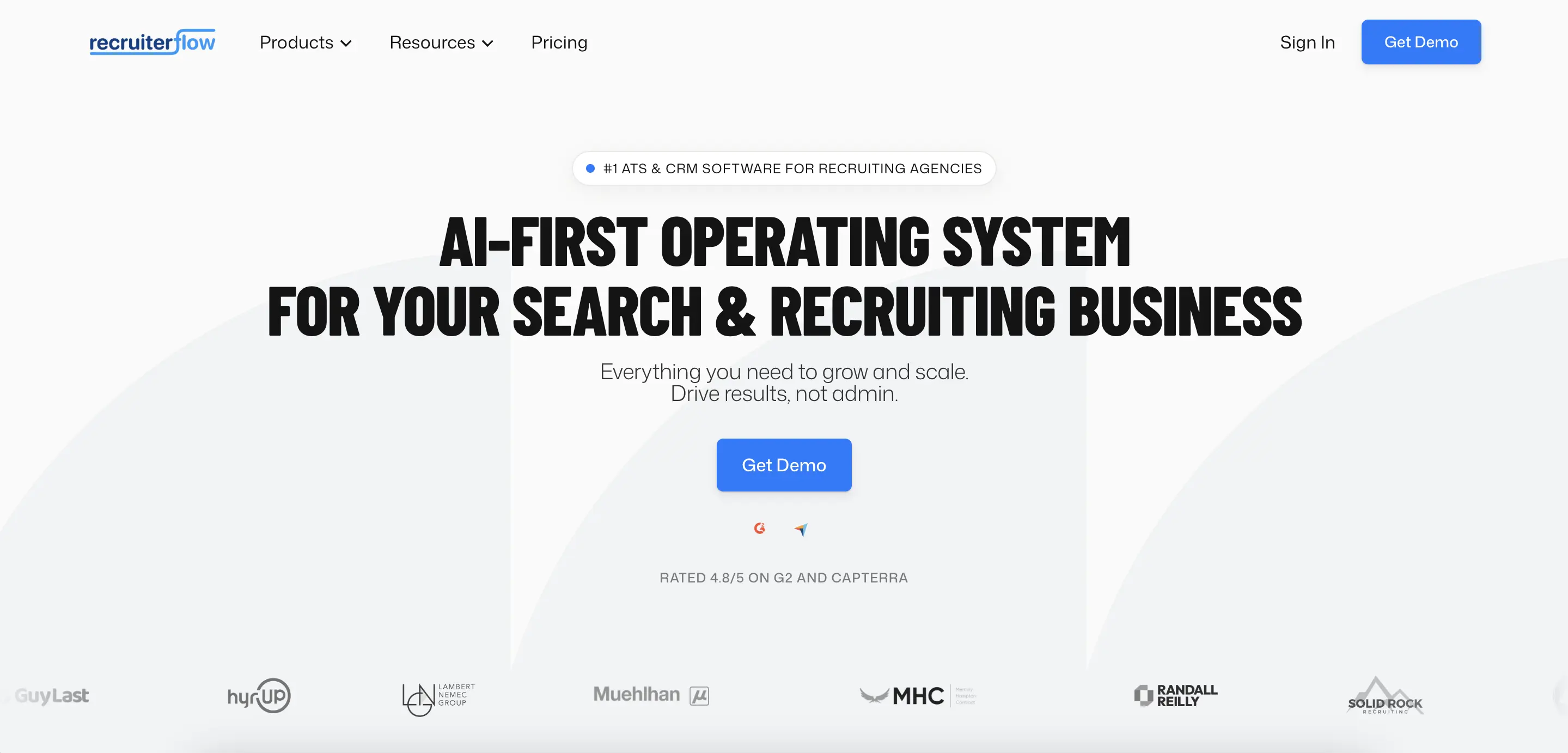
Recruiterflow is an AI-native applicant tracking system and recruiting CRM built for recruiting agencies, staffing firms, and executive search teams. Co-founder and CEO Manan Shah leads the company, which has been bootstrapped from the start with no outside funding.
Recruiterflow Features Review
Recruiterflow covers the full agency workflow, from sourcing through placement, with AIRA agents now embedded in most steps. Here's what stood out when evaluating each feature:
Unified ATS & CRM
Jobs, candidates, clients, and placements are all managed in one searchable database designed for agency workflows. I moved a test candidate through several pipeline stages, and the interface remained responsive. Every stage change automatically logged to the candidate's record without a separate note.
Client records track deal stages, contacts, and submission history in the same system. This means a recruiter working on a job order and an account manager tracking a client relationship both see the same data. I compared the CRM's depth against a staffing CRM like Bullhorn. I found that Recruiterflow covers the core well but lacks some deeper enterprise features around invoicing and contractor management that larger agencies rely on.
AIRA AI Agents
AIRA is the collective name for over a dozen AI agents built into the recruiting workflow, each handling a specific task. I tested AIRA Source against a mock requisition, and it returned ranked candidates from an 850-million-profile external database. It also included matches already in the agency's CRM, with the CRM results prioritized since that's where most placements come from.
AIRA Matchmaker scores existing CRM candidates against a new role. Notetaker joins calls, summarizes them, and updates the candidate record automatically. Submission Agent drafts client-ready candidate write-ups. Research Agent gathers company and contact intelligence before outreach. Job Change Alert Agent flags when a candidate switches roles, a signal most agencies miss. The full AIRA suite requires the custom-quoted AIRA Plan rather than the published Platform Plan, which agencies should clarify before signing.
Multichannel Sequences & Outreach
Sequences 2.0 coordinates outreach across email, SMS, and LinkedIn from one builder. It includes automated follow-ups that pause when a candidate responds. I built a three-step email and SMS sequence for a batch of sourced candidates, and the system handled scheduling and send-time optimization without manual intervention.
Email Generation Agent drafts personalized messages using job and candidate context, while the Outreach Agent manages sequencing logic. Email deliverability is generally strong, though daily send limits can cap high-volume campaigns, staggering outreach over additional days instead of completing a batch in one go.
Chrome Extension & LinkedIn Sourcing
The Chrome extension imports candidate profiles from LinkedIn, GitHub, and other sources directly into the CRM with a single click. It automatically parses contact details and work history. I added several candidates from LinkedIn profiles during testing, and each record appeared in the CRM within seconds, parsed and tagged to an open role.
Bulk sourcing mode allows recruiters to import multiple profiles from a LinkedIn search results page in one go instead of one at a time. Contact enrichment surfaces verified email addresses and phone numbers on demand. I checked accuracy against a few known profiles, and most contact details resolved correctly, though a few returned outdated employer information from recent role changes.
Workflow Automation (Recipes)
Recipes are Recruiterflow's trigger-based automation engine. They handle repetitive tasks like auto-adding candidates to a nurture sequence after 90 days of inactivity, sending status notifications when a candidate changes stages, or alerting a manager when a new submission is made. I configured a test Recipe, and the trigger fired correctly within the pipeline without any code.
The automation builder covers standard if-then logic well. More complex, multi-condition workflows with branching paths require more configuration effort than the interface initially suggests. Agencies with elaborate approval chains should test their specific use case during the trial.
Reporting, Analytics & Recruiterflow BI
Standard reports cover pipeline activity, placement metrics, and sourcing channel performance, along with a dashboard builder for custom views. I built a custom report filtering placements by recruiter and source, and the process took fewer clicks than expected for a platform at this price point.
Recruiterflow BI, a newer addition, provides predictive insights into sales data, revenue impact, and performance trends. It goes beyond historical reporting into forward-looking analysis. BI features are part of the custom-quoted AIRA Plan. Agencies on the Platform Plan receive the standard reporting suite, which meets operational needs well but lacks the predictive depth BI offers.
Client Portal & Candidate Submissions
The Client Portal gives hiring managers a branded view of submitted candidates with feedback tools. This allows evaluation to happen inside the system rather than over email threads. I generated a test candidate submission, and the branded summary automatically included every note, stage, and interview detail.
Submission Agent drafts a written candidate summary that aligns strengths with the role's requirements in one click. Candidate Experience features let applicants track their own status through a self-service portal. One gap I found is that the portal's customization options for branding are functional but not especially deep compared to dedicated client-facing tools.
Integrations & API
Recruiterflow integrates natively with Gmail, Microsoft Outlook, Microsoft 365, Google Calendar, Indeed, LinkedIn Jobs, Twilio, Slack, Zapier, Dice, and ZipRecruiter. I checked the Slack integration, and pipeline notifications posted within seconds of a candidate status change.
An open API with webhook support allows for custom integrations beyond the native list. The integration count is smaller than Bullhorn's 300-plus marketplace or Loxo's broader connector set. This fits Recruiterflow's approach of keeping the core platform self-contained rather than relying on a wide third-party ecosystem.
Recruiterflow Pricing Review
Recruiterflow publishes one plan on its pricing page, with the AI-forward tier quoted separately.
Every plan carries a 3-seat minimum, so the smallest possible annual contract is $4,284. The Platform Plan includes core AIRA agents, but the full suite, including Source, Matchmaker, BI, and advanced agents, requires the custom-quoted AIRA Plan.
Some third-party estimates place AIRA Plan pricing between $149 and $200 per user per month depending on seat count, though Recruiterflow hasn't confirmed these figures. There is no free plan, but a free trial is available without a credit card.
Recruiterflow Security and Compliance
Recruiterflow holds SOC 2 and ISO 27001 certifications, as confirmed on the platform's homepage and in its compliance documentation. GDPR compliance is integrated into the platform's data handling. It includes features like consent management and data deletion workflows for agencies processing EU candidate data.
Role-based permissions determine who can access candidate, client, and financial data within the system. SLA-backed support and dedicated implementation are available on all paid plans.
For agencies serving enterprise clients with strict vendor security requirements, SOC 2 and ISO 27001 together offer a verifiable compliance posture instead of just self-reported claims.
Recruiterflow Pros & Cons
Strengths of Recruiterflow
Based on my evaluation and verified user feedback, here are the standout pros of Recruiterflow:
- ATS and CRM Depth Designed for Agencies, Not Adapted: The unified candidate and client database is purpose-built for agency workflows, not a generic HR platform repurposed for staffing, so deal tracking and submissions work the way an agency expects them to.
- AIRA Agents Cover the Full Recruiting Lifecycle: The agent ecosystem handles sourcing, matching, call capture, client submission, and enrichment as connected steps rather than isolated features, so each agent builds on what the previous one did.
- Ease of Use Backed by High Scores Across Major Review Platforms: Ease of use scores 4.7 out of 5 across 332 verified reviews on the highest-volume review site, and onboarding new recruiters takes days rather than weeks according to multiple verified customers.
- Bootstrapped Product Velocity: Despite no outside funding, Recruiterflow claims a new feature or update every 72 hours, and the pace of AIRA agent releases through 2026 backs that claim up with observable product movement.
- Customer Support Gets Consistent Praise: Support response quality and implementation help are the highest-rated aspects of the platform across both major review sites, frequently cited as the reason agencies stayed through initial setup.
Limitations of Recruiterflow
Despite these highlights, the same users reported several cons of Recruiterflow that you should be aware of:
- Full AI Agent Access Requires the AIRA Plan: The most differentiated AIRA agents, including Source, Matchmaker, and BI, stay behind a custom quote rather than the published $119 entry price.
- Reporting Depth Has a Ceiling on the Platform Plan: Standard reports cover operational metrics well, but predictive analytics and BI features require upgrading to the AIRA Plan.
- Integration Ecosystem Is Narrower Than Larger Competitors: Agencies that depend on a wide stack of third-party tools will find Recruiterflow's native connector list smaller than Bullhorn or Loxo.
- No Automated Screening: AIRA's agents focus on outbound sourcing and CRM mining rather than systematically evaluating every resume that arrives through a job posting.
- Mobile Experience Lags the Desktop Platform: Some verified customers describe the mobile app as less polished than the desktop interface, particularly for admin-level tasks.
How Integrating Skima AI Can Handle Recruiterflow's Limitations
AIRA's agents focus on outbound sourcing, CRM mining, and workflow automation. However, they don't systematically screen every inbound resume against a role's specific requirements. Past candidates in the CRM are surfaced through Matchmaker for active searches.
Still, there's no continuous, automatic screening of new applications as they arrive. Recruitment agencies using Recruiterflow often integrate Skima AI to close these gaps. Here’s what the integration provides:
- Job Description Compliance Check: Before a role goes live, Skima AI reviews the job description for language that could introduce legal, bias, or compliance risks. It flags issues before they affect the candidate pool.
- AI Candidate Screening for New Applicants: As candidates apply for a role synced from Recruiterflow, Skima AI evaluates each resume against the job's requirements. It automatically ranks the pool, allowing a recruiter to open a prioritized shortlist instead of reviewing every application by hand.
- Talent Rediscovery for Past Candidates: Skima AI scans an agency's existing Recruiterflow database for candidates who were screened before but never placed. It surfaces qualified matches for a new opening without requiring a fresh outbound search each time.
- Candidate De-Duplication and Enrichment: Skima AI automatically merges duplicate candidate records matched by email, phone, LinkedIn URL, or a combination of name, location, and company. It fills in missing profile fields from context, keeping an agency's Recruiterflow database clean instead of accumulating the same candidate under multiple entries.
- Explainable Match Scoring Behind All Three: Every candidate (new or rediscovered) receives a score with specific reason bullets covering skills, experience, and certifications. This approach provides transparency, so a recruiter can see exactly why a candidate ranked where they did.
Who Is Recruiterflow Best For?
Recruiterflow is ideal for recruiting agencies, staffing firms, and executive search teams with 3 to 50 users. It combines ATS, CRM, outreach, and AI agents into one user-friendly platform.
It’s also ideal if you need a unified system for managing candidate and client pipelines, rely on LinkedIn for sourcing, or prefer AI agents that streamline sourcing and submissions. Plus, it’s cost-effective compared to Bullhorn with a simpler setup.
Who Should Avoid Recruiterflow?
Avoid Recruiterflow if you're a solo recruiter or a small team unable to meet the three-seat minimum. Additionally, if your in-house talent team focuses on processing inbound applicants rather than sourcing, or requires deep AI candidate scoring without extra costs, it may not suit your needs.
Final Verdict: Should You Buy Recruiterflow?
Yes, if you’re a recruiting agency or executive search firm looking to consolidate your ATS, CRM, and outreach tools, AIRA offers a comprehensive solution. Its ecosystem delivers a thorough agent suite with a steady stream of new agent releases expected through 2026, indicating ongoing expansion.
However, if your budget is limited to the Platform Plan and essential AIRA agents are priced separately, or if your focus is on inbound applicant processing, consider Recruiterflow alternatives. For those ready to invest fully, Recruiterflow in 2026 provides superior
Frequently Asked Questions
1. What is Recruiterflow?
Recruiterflow is an AI-first applicant tracking system and CRM for recruiting agencies that consolidates sourcing, multichannel outreach, candidate enrichment, automation, and reporting to significantly accelerate hiring and reduce administrative workload.
2. Is Recruiterflow legit?
Yes, Recruiterflow is a legitimate ATS and CRM used by recruiting agencies. It has verified reviews on G2 and Capterra, provides customer support, security measures, and transparent pricing, plus enterprise options.
3. How much does Recruiterflow cost?
Recruiterflow’s public pricing starts at $149 per user per month for the Advanced plan. Annual billing discounts and custom enterprise plans with full AI features are available.
4. What integrations does Recruiterflow support?
Recruiterflow integrates with sourcing tools, email providers, phone systems, Zapier, and job boards; it offers an open API and webhooks for custom integrations, though some boards or enterprise connectors may require vendor configuration.
5. Does Recruiterflow integrate with Skima AI?
Yes, Recruiterflow can integrate with Skima AI via API, webhooks, or middleware to enable normalized resume parsing, explainable match scoring, and write-back of scores, tags, and shortlist flags into candidate records for faster screening.
6. How does Skima AI improve Recruiterflow’s screening?
Skima AI streamlines resumes and reduces duplicate profiles. It gives clear match reasoning with scores and auto-tags qualified candidates. It can also trigger stage automation. This boosts shortlist relevance, recruiter efficiency, and audit trails in Recruiterflow workflows.