













Workable is a cloud-based applicant tracking system and HR platform that combines job board distribution, AI-powered sourcing and screening, and core HR tools like onboarding and time tracking in one system.
- Primary Features: Applicant tracking, Workable Agent (AI recruiting), candidate sourcing, career page builder, video interviews and assessments, interview kits and scorecards, reporting and analytics, and HR tools including onboarding, time & attendance, and e-signature.
- Starting Price: Published pricing ranges from a pay-per-job option to $719 per month for Enterprise. The Standard tier is priced at $299 per month and scales based on employee headcount.
- Best For: Small to mid-market companies, roughly 10 to 500 employees, that hire steadily throughout the year and want recruiting plus core HR in one platform without a long sales cycle.
- Not Ideal For: Staffing agencies and RPOs needing multi-tenant, multi-client architecture, or teams that want AI-driven candidate ranking and rediscovery operating continuously in the background rather than triggered manually per job.
- Integration: Recruiting teams integrate Skima AI with Workable to deepen candidate screening, talent rediscovery, and match transparency, all without replacing Workable.
Workable is one of the more interesting platforms I've evaluated recently, because it launched an entirely new AI product in March 2026, not a rebrand of an existing feature. Workable Agent operates the sourcing-to-shortlist workflow autonomously inside the ATS.
I evaluated the core ATS, the new Agent, and the surrounding HR layer, then analyzed patterns from more than a thousand verified user reviews to see where that reputation holds up and where it doesn't. Let's get into it.
What Is Workable?
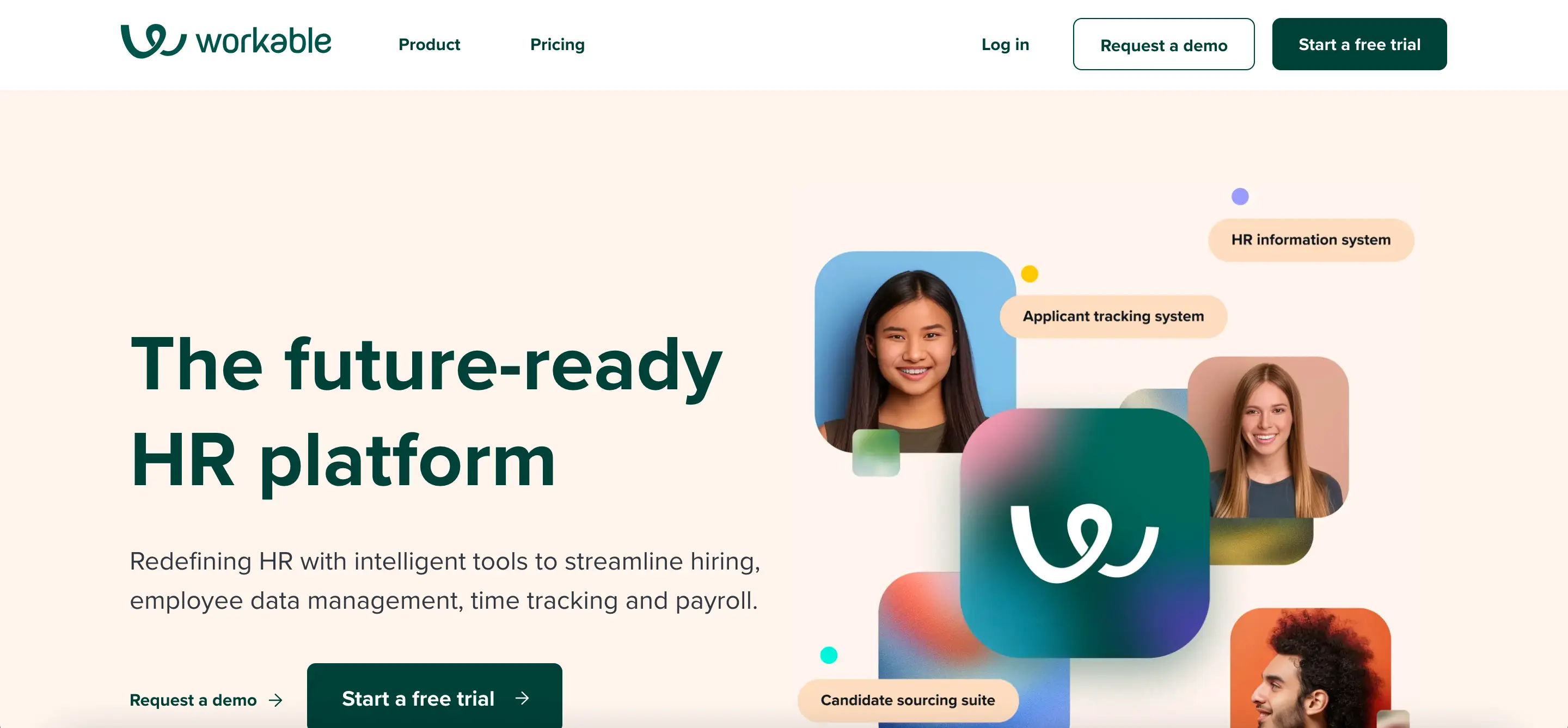
Workable is a cloud-based applicant tracking system and HR platform built to source, screen, and hire without the overhead of enterprise recruiting software. Nikos Moraitakis co-founded the company with Spyros Magiatis and still leads it today as CEO.
Additionally, the company has leaned hard into AI positioning over the past year, describing itself as building "agentic software for recruiting and HR" rather than an ATS with AI features bolted on.
Workable Features Review
Workable organizes its product around the core ATS, the Workable Agent AI layer, candidate sourcing and career pages, interviews and assessments, reporting, and an HR module for the post-hire employee lifecycle. Below is my honest evaluation of each feature, highlighting what it does well and where it still has limitations:
Applicant Tracking System
Every job requisition, candidate pipeline, and hiring approval is stored in one place. I found the pipeline view quick to navigate. Custom stages, bulk actions, and permission-based access are just a click or two away.
Approval flows and budget controls allow a company to gate new requisitions before sourcing begins. This is important when more than one hiring manager is involved.
Multiple candidacies for the same person are tracked per job instead of being merged into one account-wide profile. So, if a candidate applies to two roles, they end up with two separate records. This keeps evaluations job-specific. However, a recruiter must actively check the "Also in x other jobs" indicator to see a candidate's full history.
Workable Agent
Workable Agent works differently from a typical AI add-on. A recruiter describes the role in conversation, and the Agent converts that into a structured job brief, must-haves, and disqualifiers before writing the job description.
Structured intake is free with every Recruiting plan. The autonomous version, which sources, screens, and engages candidates from start to finish, is a paid add-on billed by credits.
Once active, the Agent searches Workable's database for passive candidates. It sends personalized outreach and evaluates every inbound applicant based on up to 14 job-specific criteria. Workable notes that each score includes a written reason for the recruiter to review. If any information is missing, the Agent chats with the candidate to fill in the gaps before re-scoring.
I see this as a legit different architecture from typical AI screening, since it handles an entire sourcing motion instead of just ranking an inbox. However, the launch is five months old, and a second phase covering interview and email analysis is still to come.
Candidate Sourcing & Job Board Distribution
A single job post distributes to job boards, and Indeed Platinum and LinkedIn Preferred Partner status means Apply with Indeed and Apply with LinkedIn feed directly into the pipeline without extra setup. I found the one-click posting saves the afternoon most teams would spend re-entering the same requisition across five sites.
In addition to active postings, Workable's own database supports passive sourcing. A resurfacing tool searches historical candidates and the Talent Pool for new openings, tagging them with labels like Competency, Culture Fit, and Likelihood to Move.
This resurfacing requires a manual trigger for each job instead of operating automatically. It surfaces qualitative labels rather than a score linked to the role's requirements.
Career Pages & Candidate Experience
The career page builder is drag-and-drop and requires no coding, and I noticed it's quick to get a branded, mobile-friendly page live with custom colors, fonts, and an embeddable widget for a company's existing website. Application forms auto-fill from a resume upload, shortening the path from clicking a job-board listing to submitting an application.
Job posts, applications, and offers translate into six languages for companies hiring across borders. The candidate-facing side of the process feels well thought out, which helps a smaller team appear more established than its headcount would suggest. Internal referral tools and a gamified employee job board complete this module for companies that rely on their own staff to source candidates.
Interviews, Scorecards & Assessments
Interview kits and structured scorecards standardize what every interviewer evaluates in a candidate. I found this to be the underrated part of the platform for companies without a dedicated recruiting operations function. It ensures consistency with minimal setup work.
Built-in video interviewing supports both live and recorded formats. Self-scheduling allows candidates to choose a time slot without back-and-forth emails.
Science-backed assessments and SMS messaging complete the process, but both are available only as add-ons in the Standard tier, not included by default. Feedback from every interviewer is collected in one place, linked to the candidate and the stage. This way, a hiring decision has a documented trail instead of relying on a recruiter's recollection weeks later.
Reporting & Analytics
A visual Report Builder includes the hiring plan, hiring performance, and attendance data. Recent updates added department grouping and a dedicated Job Details report that consolidates lifecycle, posting, and candidate data into one export.
I found building a first custom report straightforward. The recent conditional formatting update, which highlights problem rows in red or orange, makes it noticeably faster to scan a busy report.
Standard, pre-built reports are included with every plan. However, the ability to create fully custom reports and assign additional permission sets is limited to the Enterprise tier. The out-of-the-box reporting is functional but becomes constrained when requests go beyond the built-in templates, especially for cross-departmental comparisons.
HR & Workforce Management
Once someone is hired, onboarding checklists, e-signatures for offer letters and policies, time and attendance tracking, and org charts keep that person's record updated without requiring information to be re-entered.
Payroll preparation connects to partners like ADP and Xero instead of processing payroll in-house. This is a sensible choice for a company that already has payroll systems in place.
Compliance support covers GDPR, EEO, and CCPA, with audit trails that document changes for later review. This module is ideal for a company that wants recruiting and basic HR under one login. However, it is not a complete HRIS replacement for complex, multi-country workforce needs. The depth here complements the ATS rather than competing with a dedicated HR platform.
Workable Pricing Review: Is It Worth the Investment?
Workable stands out by publishing its pricing openly, unlike many competitors who hide costs behind sales calls. The Standard plan starts at $299 per month, based on headcount rather than recruiter seats, and offers a 15-day free trial without requiring a credit card.
However, the $299 covers core recruiting only. Texting, video interviews, assessments, and performance reviews are additional add-ons, priced between $39 and $109 each, which can raise the cost to nearly $600 monthly.
Premier is $599 per month and includes features like AI Recruiter and video interviewing. Meanwhile, Enterprise is $719 and offers custom reporting and expanded permissions.
Workable also audits headcount periodically. A company that grows from 45 to 55 employees mid-contract should expect the bill to adjust accordingly. Get a quote that includes every add-on your team actually needs before comparing the total against a competitor's published price. The headline figure often understates what a fully equipped account costs.
Workable Marketplace
Workable Marketplace connects with over 270 third-party tools, including BambooHR, ADP, Skima AI, and Microsoft Teams. Its open API enables development teams to create custom integrations beyond the native library. Additionally, the expanded MCP server offers access to 94 tools and AI assistants like Claude or ChatGPT, allowing teams to manage Workable directly.
For companies already using payroll or background-check tools, this integration flexibility allows Workable to enhance existing systems without requiring a complete replacement. However, multiple users have indicated that Workable's API documentation is less comprehensive than Greenhouse's, which could impact custom integration efforts.
Workable Reviews: Pros & Cons
Based on my evaluation and cross-referencing verified user reviews, these are the standout strengths of Workable:
- Fast, Intuitive Setup: Users consistently reported getting a first job posted and a careers page live within hours, with little to no training required for hiring managers.
- Published, Transparent Pricing: Unlike most competitors in this category, Workable lists real numbers on its site, which multiple reviewers cite as a genuine trust signal during evaluation.
- Strong Sourcing Reach: The combination of 200+ job boards and a 400 million-plus profile database gets reviewers consistently positive marks for surfacing candidates without extra tools.
- Responsive Customer Support: Verified users across platforms describe support as knowledgeable and quick to respond, including direct follow-up from account managers on specific feature requests.
- Rapid Product Velocity: Users who returned to Workable after a gap describe being positively surprised by how much the platform added, citing automation, reporting, and video interviews as recent, meaningful additions.
Despite these strengths, the same users reported several cons of Workable that you should be aware of:
- Reporting Customization Has a Ceiling: Custom report building and additional permission sets require the Enterprise tier. The standard reporting is limited once a request goes beyond the built-in templates.
- Add-On Costs Add Up Fast: Texting, video interviews, assessments, and performance reviews are priced separately on the Standard plan. Stacking these options pushes the effective monthly cost close to what the next tier costs.
- Per-Job Candidate Profiles Create Duplication: Workable's documentation confirms the platform detects duplicates by email on a job basis, not account-wide. Profile merging is not supported. Verified reviewers report duplicate entries and inconsistent syncing as ongoing issues.
- AI Matching Precision Still Varies: A verified user specifically noted that CV filtering "could be more precise." Workable Agent's scoring and reasoning system has not yet developed the independent track record that a mature, audited system would have.
- Resurfacing Is Manual, Not Continuous: Finding past candidates requires a recruiter to actively trigger a search for each new job. The platform does not proactively surface matches as new openings are created.
How Integrating Skima AI Can Handle Workable's Limitations
Workable's candidate resurfacing only happens when a recruiter manually triggers it for each job, rather than continuously. Matches are shown as qualitative labels instead of scores tied to specific job requirements.
Additionally, separate per-job candidate profiles mean the same person can exist multiple times without a way to merge them. To address these limitations, recruitment teams integrate Skima AI for continuous automation, itemized scoring, and clean, de-duplicated records without replacing Workable. Here is what the integration provides:
Here is what the Skima AI integration adds:
- Job Description Compliance Check: Before a requisition goes live, Skima AI flags gender and age-coded language, audits inflated requirements that could indirectly exclude protected groups, and confirms a compensation range is included where local law requires it, catching exposure at the source rather than after applications start arriving.
- Continuous AI Candidate Screening: As candidates apply for a job synced from Workable, Skima AI screens and ranks each resume against the role's actual requirements automatically and continuously, rather than requiring a recruiter to trigger a scan.
- Automated Talent Rediscovery: Skima AI scans a company's existing Workable database for candidates who were screened before but never hired, surfacing qualified matches for a new opening on its own instead of waiting for a recruiter to open the resurfacing tool for that specific job.
- De-Duplication and Profile Enrichment: Skima AI merges duplicate candidate records across jobs, matched by email, phone, LinkedIn URL, or a combination of name, location, and company, and fills in missing profile fields from context, addressing the per-job duplication Workable's documentation confirms it does not resolve natively.
- Explainable Match Scoring Tied to Job Requirements: Every score comes with reasons itemized against specific skills, years of experience, and certifications, rather than a qualitative label, so a recruiter or hiring manager can see the exact evidence behind a ranking.
Who Is Workable Best For?
Workable is best for small to mid-market companies that hire consistently throughout the year and want recruiting plus a light HR layer in one platform rather than a separate point solution for every stage. Strong fit if:
- You operate a company with 10 to 500 employees handling 10 to 200 hires a year without a large dedicated talent acquisition team
- You want published, self-serve pricing and a full-featured 15-day trial before committing to a contract
- Your hiring managers need to get productive quickly without a multi-week implementation
- You value AI-assisted sourcing and screening but want it built into your core ATS rather than a bolt-on tool
- You need core HR basics like onboarding, time tracking, and e-signature without adopting a separate HRIS
Who Should Avoid Workable?
The speed and simplicity that make Workable appealing to growing companies become real constraints for organizations with more complex needs. Avoid Workable if:
- You operate a staffing agency or RPO that needs multi-tenant, multi-client architecture rather than a single-company system
- You need a fully custom reporting engine and granular permission sets without paying for the Enterprise tier
- You require continuous, automatic candidate rediscovery rather than a resurfacing tool triggered per job
- Your team is building deep custom integrations and needs thorough, detailed API documentation
- You need a full HRIS with deep multi-country payroll processing rather than a light HR layer connected to payroll partners
Final Verdict: Should You Buy Workable?
I'd recommend Workable for small and mid-market companies that want quick implementation, clear pricing, and a robust sourcing engine without an enterprise sales cycle. The Workable Agent is a good innovation, and even in its early stages, it changes the equation for teams considering a separate AI sourcing tool.
However, I would advise staffing agencies to look elsewhere if they require advanced custom reporting without Enterprise costs or autonomous candidate rediscovery.
For those wanting immediate solutions, integrating Skima AI with an existing Workable account offers job description compliance checks and clean candidate records, making it a more practical choice than waiting for Workable Agent's next phase.
Frequently Asked Questions
1. Is Workable legit?
Yes, Nikos Moraitakis co-founded Workable with Spyros Magiatis and still leads it today as CEO. The company has leaned hard into AI positioning over the past year, describing itself as building "agentic software for recruiting and HR" rather than an ATS with AI features bolted on.
2. What is Workable used for?
Companies use Workable to post jobs, source and screen candidates, manage hiring pipelines, conduct interviews, and extend into core HR tasks like onboarding, time tracking, and e-signature, all from one platform.
3. How much does Workable cost?
Workable publishes its pricing: Standard starts at $299 per month, Premier at $599 per month, and Enterprise at $719 per month, all scaling by employee headcount. A 15-day free trial is available with no credit card required.
4. Does Workable have AI features?
Yes, extensively. Workable Agent, launched in March 2026, handles structured job intake, passive candidate sourcing, and applicant screening with stated reasoning behind every score, and it was named the best overall AI recruiting platform in a 2026 industry comparison.
5. Is Workable good for staffing agencies?
Not particularly, Workable's architecture is built for a single company managing its own hiring, not a multi-tenant model for agencies or RPOs managing recruiting across multiple clients.
6. Is Workable an ATS or an HR platform?
Both, the core product is an applicant tracking system, and Workable has layered on HR tools including onboarding, time and attendance, e-signature, and payroll preparation that connects to partners like ADP and Xero.