
















ADP Workforce Now is a human capital management platform built on a single database, unifying payroll, HR, benefits, talent management, time tracking, and compliance.
- Primary Features: Payroll and tax compliance, recruiting and applicant tracking, core HR and SmartCompliance, time and attendance, talent and performance management, benefits administration, ADP Assist AI, and workforce analytics.
- Starting Price: Pricing is quote-only and not published. Independent estimates the core platform around $23 to $30 per employee per month, with recruiting and other modules priced as separate add-ons.
- Best For: Mid-market companies, roughly 50 to 1,000 employees, that want payroll accuracy and compliance depth backed by decades of tax expertise.
- Not Ideal For: Companies that want a modern, purpose-built recruiting experience, fast customer support response times, or a lighter platform without ADP's broader ecosystem.
- Integration: Teams integrate Skima AI with ADP Workforce Now to screen new applicants, rediscover past candidates who fit new openings, and score every match with clear, explainable reasoning and compliance, all without replacing.
ADP has been processing payroll since 1949, and that depth still shows up as the platform's clearest strength decades later. What's changed more recently is how hard ADP is pushing AI into the rest of Workforce Now, not just payroll, but recruiting, analytics, and a growing marketplace of third-party agents.
I evaluated every core module, tested the newer AI Assist features against what ADP claims for them, and checked all of it against verified user feedback rather than ADP's own marketing.
My review covers what actually works day to day, where the AI additions are actually useful versus still maturing. It also includes my evaluations of all features, pricing, pros and cons. Let's get into it.
What Is ADP Workforce Now?
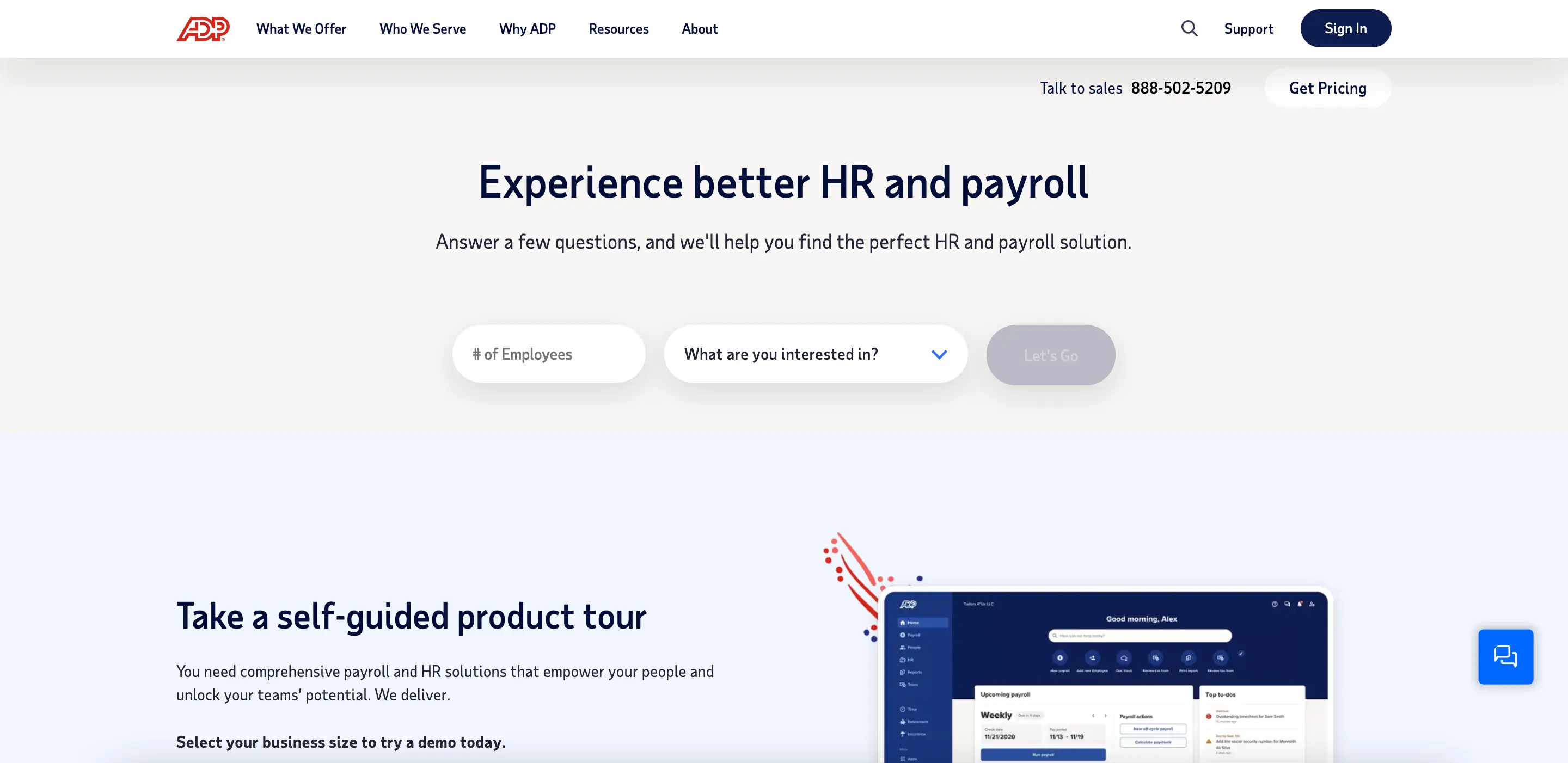
ADP Workforce Now is a cloud-based human capital management platform built on a single database, designed to give mid-market businesses payroll, HR, benefits, and talent management in one connected system. Automatic Data Processing was founded in 1949, and Maria Black has served as President and CEO since January 2023, becoming the company's seventh chief executive.
ADP Workforce Now Features Review
ADP Workforce Now includes payroll, HR and compliance, recruiting, time and attendance, talent management, and benefits. ADP Assist serves as the AI foundation across the platform. Below is my evaluation of each feature, highlighting what it does well and where it still has limitations:
Payroll & Tax Compliance
Payroll calculations, deductions, and tax filings are processed automatically. I tested a mid-cycle pay adjustment and saw it flow through correctly without needing a manual recalculation step. ADP's tax expertise is evident here: filings update automatically as federal, state, and local regulations change. This is crucial for a company operating in multiple states.
ADP Assist now adds anomaly detection, flagging unusual payroll entries before a pay cycle processes instead of after an employee notices a wrong paycheck. I found this proactive catch reassuring during testing, as these errors used to surface only after the damage was done.
SmartCompliance, the add-on suite for tax filing, wage garnishments, and employee verification, further extends this depth for companies with more complex compliance needs.
Recruiting & Applicant Tracking
Job postings are distributed to over 25,000 sites through JobTarget. An embedded ZipRecruiter connection adds smart matching specifically for companies with 50 to 999 employees.
I moved a test candidate through the pipeline and noticed the process worked. However, it took more clicks than I expected to go from application to scheduled interview compared to a purpose-built ATS.
Candidate Relevancy, the AI matching layer, compares a resume's skills, education, and experience against the job description. It does this without considering protected demographic details, and I appreciated that this design choice was stated explicitly rather than left to assumption.
However, nothing in the module automatically or manually resurfaces a past applicant when a similar role opens later. Independent comparisons against dedicated recruiting platforms consistently report this module as reflecting payroll-system priorities rather than a recruiter-first design.
HR & Compliance
Employee records, organizational structure, and document storage are all in one centralized database. I found that updating an org chart during testing reflected instantly across every connected module, rather than needing a separate sync. Self-service access allows employees to view pay stubs, update personal details, and access tax documents without opening an HR ticket.
Garnishment processing and employee verification go through the same compliance engine that handles tax filing. I noticed this keeps everything in one audit trail instead of spreading it across separate tools.
The tradeoff appears in navigation. Some screens need more clicks than the task's complexity would suggest. A new admin should expect a real ramp-up time before the structure feels intuitive.
Time & Attendance
Time capture, scheduling, and PTO tracking connect directly to payroll, so an approved overtime hour shows up in the next pay calculation without needing a manual export. I logged in through the mobile app during testing and found the real-time pay preview on timecards, a recent addition, consistently useful for spotting errors before payroll processes.
Geofenced punching confirms that an employee clocked in from the correct location. This is important for companies managing distributed or field-based teams. Setting up complex shift patterns requires real setup time. A company expecting a plug-and-play experience like a standalone time-tracking app should budget for that learning curve upfront.
Talent Management & Performance
Goal setting, performance reviews, and compensation planning all connect to the same employee record that feeds payroll and benefits. This means a completed review and an approved raise don't require re-entering the same data twice.
I walked through a mock review cycle and found the workflow straightforward for a standard annual or semi-annual process.
Learning management rounds out the module, allowing a company to assign and track training completion from the same platform. However, I noticed a lack of deeper flexibility. Teams that prefer frequent, informal feedback cycles instead of a scheduled review process may find the structure more rigid than what a dedicated, continuous-feedback tool offers.
Benefits Administration
Open enrollment, life-event changes, and carrier connections all go through the same employee database as payroll. This means that when you update your benefits election, the deductions are updated automatically instead of relying on a separate data feed. I went through a mock enrollment and found the guided comparison between plans easier to follow than a flat spreadsheet of options.
ADP's size as a benefits administrator is evident in its relationships with carriers and its ability to handle compliance across different states.
However, the complexity of configuration increases with the variety of plans. A benefits team managing many different plan types across locations should be prepared for significant setup time to ensure that every local detail is accurately reflected.
ADP Assist & AI Marketplace Agents
ADP Assist is the AI layer that extends across Workforce Now. Its most recent addition is payroll anomaly detection, which catches real errors before they reach an employee's paycheck instead of after.
The same AI foundation now powers the job description generator in recruiting and provides intelligent insights within analytics. This reduces the number of requests that used to take days to answer manually.
A new AI Agents section in ADP Marketplace, launched in March 2026, allows companies to add curated third-party agents from partners like Salary.com, Tapcheck, and Quantum Workplace. These agents handle tasks such as sourcing, pay benchmarking, and engagement. This marketplace layer looks promising but still feels early.
Most of these agents launched within the last several months, and I haven't found the kind of independent, multi-year track record that would allow me to call the results proven rather than plausible.
Reporting & Analytics
Compensation and workforce benchmarking utilize over 39 million employee records. I found that comparing our test company's pay bands to those of similar organizations provided a specific and useful reference point, rather than just a generic industry average.
Standard dashboards include recruiting, compensation, and learning progress. They feature visual charts that are easy to understand, even for those without a background in report building.
Custom report building is an option, but I noticed that conditional formatting and AI-based sentiment analysis are not part of the standard toolkit. Teams looking for that level of detail will need to explore a dedicated analytics add-on or export the data elsewhere. The benchmarking data is particularly impressive, as few competitors can offer a dataset of this size.
ADP Workforce Now Pricing Review: Is It Worth the Investment?
ADP does not publish pricing; quotes are customized based on company size, chosen modules, and add-ons. To get an actual figure, you must consult an ADP sales representative.
Independent estimates suggest the core platform, which includes payroll and basic HR, costs about $23 to $30 per employee monthly across Select, Plus, and Premium tiers. Premium adds features like time tracking and deeper analytics.
Moreover, recruiting costs around $3 per employee monthly, with a one-time setup fee of approximately $2,000 for companies with 50 to 999 employees. Implementation can range from $15,000 to $100,000, depending on size and complexity. Always request a detailed quote before comparing with competitors like Paylocity or UKG Pro.
ADP Workforce Now Marketplace
ADP Marketplace connects Workforce Now to hundreds of pre-built integrations. These include ERP systems, time and labor tools, background checks, and recruiting platforms like Bullhorn. It also offers a custom API for development teams that need connections not already covered by the marketplace.
The newer AI Agents destination extends this marketplace concept to autonomous agents. It curates partners instead of requiring a company to vet every AI vendor independently.
For companies already using other ADP products, such as ADP TotalSource for PEO services or ADP Global Payroll for international operations, this ecosystem reduces the custom integration work that would otherwise be necessary.
However, a company evaluating Workforce Now solely on its own merits, without other ADP products, will find this breadth a secondary consideration rather than a primary reason to choose the platform.
ADP Workforce Now Security and Compliance
ADP Workforce Now supports GDPR compliance and uses multi-layered encryption and access controls for employee and payroll data. Regulatory monitoring and automated alerts help companies stay updated as tax and labor law requirements change across jurisdictions.
ADP's responsible AI principles apply to both ADP Assist and the AI Agents marketplace. These principles require human oversight, explainability, and bias mitigation from all participating partners. Candidate relevancy specifically excludes protected demographic data from its scoring model. ADP makes this design choice clear rather than leaving it implicit.
Companies with specific compliance needs that go beyond what is publicly documented should confirm details directly with ADP's sales and legal teams.
ADP Workforce Now Reviews: Pros & Cons
Strengths of ADP Workforce Now
Based on my evaluation and cross-referencing verified user reviews, these are the standout pros of ADP Workforce Now:
- Best Payroll and Tax Accuracy: Users consistently credit ADP's decades of payroll expertise for reducing calculation errors and keeping tax filings up to date as regulations change.
- Genuine Benchmarking Depth: Verified users specifically highlight the value of compensation and workforce benchmarking against ADP's large dataset, finding it more useful than generic industry averages.
- Strong Self-Service Experience: Multiple users describe the employee self-service options for pay stubs, time off, and personal details as intuitive, requiring little training.
- Real Investment in AI: Users note that ADP Assist's anomaly detection and the newer AI Agents marketplace show a meaningful investment, rather than just surface-level AI branding.
- Scalable Path from Small Business to Mid-Market: Teams appreciate the ability to grow from ADP RUN into Workforce Now without needing to switch providers entirely.
Limitations of ADP Workforce Now
The same verified user base that praises ADP's payroll depth also raises consistent concerns. Below are the cons of ADP Workforce Now:
- Customer Support Response Times: This is the most frequently cited complaint across reviews, with users describing long hold times and multiple transfers before an issue gets resolved.
- Navigation Complexity: Users reported needing more clicks than expected for routine tasks, particularly for admins new to the platform's structure.
- Recruiting Feels Secondary to Payroll: Multiple users and independent comparisons describe the recruiting module as functional but built around HR administration priorities rather than recruiter workflows specifically.
- No Native Talent Rediscovery: Nothing in the recruiting module automatically resurfaces a past applicant when a similar role opens later; a recruiter has to search the database manually every time.
- AI Matching Lacks Depth Behind the Score: Candidate relevancy compares skills, education, and experience, but it doesn't provide the kind of detailed, per-requirement reasoning that would let a recruiter see exactly why one candidate ranked above another.
- Limited Reporting Flexibility: Verified users note that conditional formatting and AI-based sentiment analysis aren't available in standard reporting, requiring a workaround for deeper analysis.
How Integrating Skima AI Can Handle ADP Workforce Now's Limitations
ADP's Candidate Relevancy compares a resume against the job description, but it doesn't rediscover past applicants or explain why one candidate scored higher than another, which is now required under the EU AI Act and New York City Local Law 144.
To close these recruitment gaps, I noticed companies often integrate Skima AI for continuous candidate screening, automatic talent rediscovery, and explainable scoring. It also covers a step that ADP doesn't touch: checking a job posting for compliance risk before anyone applies.
Here is what the Skima AI integration provides:
- Job Description Compliance Check: Before a requisition goes live, Skima AI flags language that may indicate gender or age bias. It audits inflated requirements that could indirectly exclude protected groups. It also confirms that a compensation range is included where local law requires it. This approach catches potential issues at the source, rather than after applications start arriving.
- AI Candidate Screening for New Applicants: As candidates apply for a job synced from ADP Workforce Now, Skima AI automatically screens and ranks each resume against the role's actual requirements. This allows a recruiter to open a prioritized shortlist instead of sorting through an unsorted queue of applications one by one.
- Talent Rediscovery for Past Candidates: Skima AI scans a company's existing ADP database for candidates who were previously screened but not hired. It surfaces qualified matches for a new opening without requiring a recruiter to start a fresh search from scratch.
- Explainable Match Scoring Behind Both: Every score includes a written explanation based on specific skills, years of experience, and certifications. This is more compliant and informative than a general relevancy comparison, allowing a recruiter or hiring manager to understand exactly why a candidate received their ranking.
Companies like Fairway Leasing and SambaSafety already use Skima AI integrated with ADP Workforce Now to save time and budget spent on sourcing, screening, and hiring.
Who Is ADP Workforce Now Best For?
ADP Workforce Now is best for mid-market companies that need payroll precision and compliance, backed by years of tax expertise. It’s a strong choice for those with 50 to 1,000 employees requiring reliable multi-state payroll.
Additionally, it’s beneficial if you value benchmarking, use other ADP solutions, prefer practical AI investments, and have straightforward recruiting needs manageable by a payroll-first ATS.
Who Should Avoid ADP Workforce Now?
Avoid ADP Workforce Now if you require quick, responsive customer support and dislike long hold times. Consider a dedicated ATS for complex recruitment volumes. If you prefer transparent pricing over custom quotes, or need advanced features like automatic candidate rediscovery and detailed reporting, this platform might not be the best fit.
Final Verdict: Should You Buy ADP Workforce Now?
I'd recommend ADP Workforce Now for mid-market companies focused on payroll accuracy, tax compliance, and in-depth benchmarking. Its robust payroll engine, built over decades, offers significant advantages. Additionally, ADP Assist's anomaly detection demonstrates the use of AI to tackle time-consuming issues.
However, for teams prioritising fast customer support, tailored recruiting experiences, or flexible reporting, I suggest considering alternatives. Companies that want continuous candidate screening and detailed scoring should integrate Skima AI with their existing ADP setup instead of waiting for the recruiting module to improve.
Frequently Asked Questions
1. What is ADP?
ADP (Automatic Data Processing) is a global HR and payroll platform that provides payroll processing, tax filing, time and attendance, benefits administration, talent acquisition tools, and managed HR services for businesses.
2. Is ADP legit?
Yes, ADP is a legitimate publicly traded HR technology company with decades of experience, serving thousands of clients globally. It complies with payroll regulations, offers audited services, and maintains industry-standard security and data practices.
3. How much does ADP cost?
ADP pricing varies by product, company size, and modules. Small-business RUN plans list base fees; mid-market and enterprise HCM, RPO, and global payroll require custom quotes obtained from ADP sales for exact totals.
4. Does ADP offer applicant tracking (ATS)?
Yes, ADP offers applicant tracking as part of its Talent Acquisition suite and marketplace partners. Features include job posting, resume management, candidate workflows, onboarding, and integrations with ADP HCM. Licensing varies by plan.
5. Can ADP integrate with Skima AI?
Yes, ADP can integrate with Skima AI via APIs or marketplace connectors to sync candidate data, scores, and feedback. Integration enables automated screening, match scoring, and write-back of candidate tags into ADP records.
6. How does Skima AI improve ADP hiring workflows?
Skima AI enriches ADP workflows by prioritizing applicants, generating explainable match-scores, and surfacing best-fit candidates. Recruiters save screening time, improve shortlist quality, and maintain audit trails within ADP records for faster hiring decisions.