














Lever is an applicant tracking system and candidate relationship management platform, branded as LeverTRM, built around the idea that recruiting means managing ongoing relationships, not just processing applications.
- Primary Features: Applicant tracking, native CRM and nurture campaigns, AI Interview Companion, Talent Fit AI matching, career pages and candidate experience tools, and Visual Insights analytics with DEI reporting.
- Starting Price: Pricing is quote-only and not published. Independent estimates place the range from roughly $6,000 a year for smaller teams up into six figures at enterprise scale.
- Best For: Mid-market and growing companies with dedicated recruiting teams that prioritize proactive sourcing and long-term candidate relationships over high-volume inbound screening.
- Not Ideal For: Small teams on a tight budget, agencies, or companies whose main bottleneck is triaging a large volume of inbound applications rather than nurturing a pipeline.
- Integration: Recruitment teams integrate Skima AI with Lever to deepen candidate screening, talent rediscovery, and match transparency, all without replacing Lever or requiring data migration.
Lever built recruiting software to track relationships, not just applications. That approach still shapes the product today, even as the company has spent the past two years adding AI features at a pace most legacy ATS platforms haven't matched.
I evaluated the core ATS and CRM, the newly acquired AI Interview Companion, and the Talent Fit matching engine against verified user feedback rather than Lever's own marketing. My Lever review covers what actually works day to day, where the AI additions perform in real-world use, and where high-volume hiring will still be a bottleneck. Let's get into it.
What Is Lever?
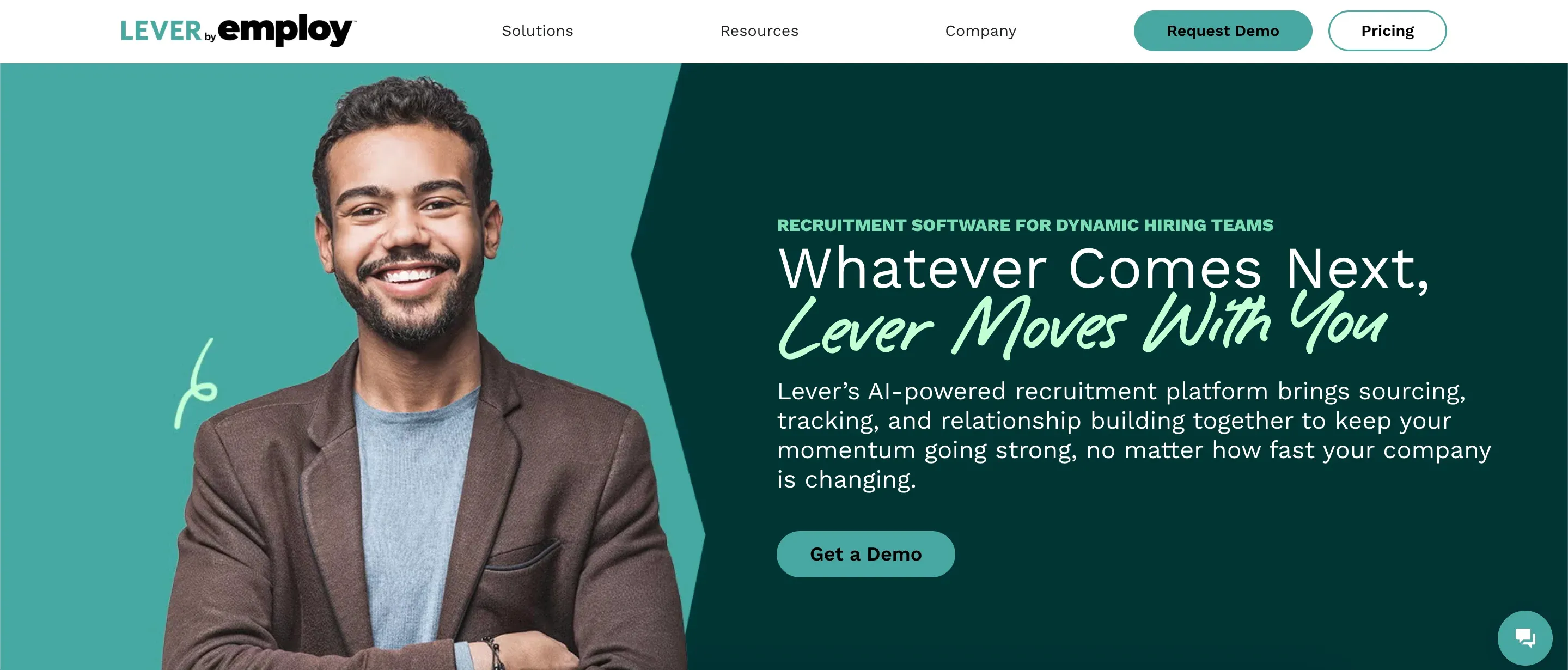
Lever is a cloud-based applicant tracking system that includes a built-in candidate relationship management layer. It is marketed as LeverTRM for Talent Relationship Management. Nate Smith co-founded the company in 2012 with Brian Noguchi, Sarah Nahm, and Randal Truong. In 2022, Employ Inc. acquired Lever, adding it to its sister brands JazzHR and Jobvite.
Lever Features Review
Lever combines ATS and CRM at its core. It includes features like the AI Interview Companion, Talent Fit matching, career pages, and Visual Insights analytics. Below is my evaluation of each feature, highlighting what they do well and where they still have limitations:
Applicant Tracking System
Job postings, customizable pipeline stages, and interview scheduling cover the standard recruiting workflow. Resume parsing automatically extracts candidate data into structured profiles. Standardized feedback forms collect interviewer input in one place. This ensures that hiring decisions are based on documented input rather than a recruiter's memory of a hallway conversation.
I moved several open requisitions through the pipeline at once. The drag-and-drop interface remained clean throughout and was quick enough for a new team member to pick up the core workflow fast.
However, I hit a wall with deep customization. Coming in with Greenhouse's granular workflow control as my reference point, I found Lever's configuration options noticeably more limited. I had to work around the built-in structure more than once instead of configuring my way through it.
CRM & Candidate Nurture
Every candidate is stored in one database, whether they're actively applying or in a nurture pipeline. This unified structure is Lever's biggest advantage over a traditional ATS. I tagged a candidate as a silver medalist after a strong interview. I also assigned them to a future role and added them to a nurture sequence, all without leaving the same candidate record.
Automated email campaigns segment candidates by skill, prior application stage, or job function. This keeps passive candidates engaged between roles instead of letting the relationship go cold once a position closes.
The tagging system works well when a recruiter uses it, but I noticed that nothing scans the entire historical database on its own. It only surfaces candidates I’ve already flagged.
AI Interview Companion
AI Interview Companion, built from Lever's 2025 acquisition of Pillar, automatically generates structured interview guides. This way, a hiring manager doesn't have to start from scratch every time a new role opens.
During a live interview, it tracks sentiment, monitors the balance of talk time between the interviewer and candidate, and flags potentially biased language in real time instead of after the interview.
I tested it during a mock interview, and the automated summary saved me the hassle of writing notes right after the call. The transcript remains attached to the candidate record for anyone reviewing the decision later. Of all the AI features in this platform, this is the one I’d consider useful from week one, as it replaces a task every interviewer used to do manually.
Talent Fit & AI Matching
Talent Fit automatically ranks candidates based on a role's requirements. It provides a clear justification for each match instead of just a score. During the matching process, identity-revealing details like race, age, gender, and disability status are removed to limit what the model can rely on.
I've evaluated many ATS-native matching tools, and this one stands out because the justification is visible rather than just promised in marketing materials.
However, I noticed that Talent Fit only ranks candidates who are already in the pipeline for an active requisition. It doesn't review my entire historical candidate base when a similar role opens later. This gap is where manual silver-medalist tagging needs to step in.
Candidate Experience & Career Pages
Branded career pages connect directly to open roles. During my walkthrough, the application flow was short enough that I didn’t feel frustrated and tempted to abandon it. Status updates and automated communication keep candidates informed between stages, so they don’t have to wonder if their application has disappeared into a queue.
I focused on where a candidate might stall in a stage. Lever's data view made it easy to spot these issues, offering a specific, practical use of the information instead of just a vague engagement metric. The candidate experience worked well in my testing for a mid-sized team.
However, a company dealing with high volumes of inbound applicants would still need a system in place to triage before candidates reach this stage.
Visual Insights & Analytics
Visual Insights addresses funnel drop-off, source effectiveness, and time-to-fill through a reporting dashboard that most teams can understand without training.
DEI analytics are included in the core product instead of being sold as an add-on. This feature tracks representation at every stage of the pipeline and highlights where underrepresented candidates tend to drop out.
Custom reporting is where this module becomes more limited. Several teams express a desire for deeper, more flexible breakdowns than the standard dashboards provide. Creating anything outside the templates typically requires exporting to a spreadsheet to complete the analysis.
The DEI reporting is a notable strength, and it is included rather than restricted to a premium tier, as some competitors do.
Lever Pricing Review: Is It Worth the Investment?
Lever does not disclose pricing. Each quote is tailored to company size, hiring volume, and the chosen tier, LeverTRM or LeverTRM for Enterprise. There’s no free trial to explore the platform beforehand.
Estimates suggest costs range from around $6,000 annually for smaller teams to six figures for larger enterprises, usually structured as one-year contracts. Advanced analytics and additional features in the Enterprise tier are priced separately, meaning a quote for the entry-level tier may not reflect the true cost of a fully equipped account.
Consider all figures as approximate since Lever hasn’t confirmed pricing. Request a comprehensive quote and clarify the Enterprise tier's benefits before comparing with competitors like Greenhouse or Workable.
Lever Marketplace
Lever Marketplace integrates with HRIS platforms, sourcing tools, assessment providers, background check vendors, and productivity tools such as Slack, Zoom, and calendar apps. Integrations with ADP and UKG specifically cover payroll and onboarding handoffs.
A DocuSign connection manages e-signatures, while a Tableau integration helps teams pull recruiting data into a broader business intelligence stack.
For companies already using common HR and productivity tools, these connections usually work smoothly without much custom development. Lever's integration library appears solid but not exhaustive. A company with a highly specialized or unusual tech stack should verify specific compatibility before assuming a pre-built connector is available.
Lever Reviews: Pros & Cons
Strengths of Lever
Based on my evaluation and cross-referencing verified user reviews, these are the standout pros of Lever:
- Native ATS and CRM in One Database: Users consistently praise the unified candidate record for eliminating the need for a separate sourcing or nurture tool, which most competitors require as an add-on.
- Clean, Fast Onboarding for New Users: Verified users reported that the interface was intuitive enough for a new hire on the recruiting team to become productive within days instead of weeks.
- Strong Automation for Scheduling and Nurture: Multiple buyers specifically cite automated interview scheduling and nurture campaigns as genuine time-savers that reduce manual coordination.
- Built-In DEI Analytics: Users highlight representation tracking and bias-aware reporting as included features rather than costly premium add-ons.
- AI Transparency: Talent Fit's stated justifications feel like real reasoning instead of a black-box score. However, recruiters still need to verify the underlying claims manually.
Limitations of Lever
Despite these strengths, the same verified users reported several cons of Lever that you should be aware of:
- Reporting Feels Limited Outside the Templates: Users find custom reporting confusing or restrictive. They often need to export data to a spreadsheet for any reporting beyond the standard templates.
- Recurring Bugs and Slow Fixes: Multiple users mention technical issues that take longer to resolve than expected. This frustration appears repeatedly in long-term user feedback.
- Limited Deep Customization: Verified buyers familiar with more configurable platforms describe Lever's workflow controls as comparatively restrictive. This is especially true when a hiring process becomes more complex than the defaults assume.
- Not Built for High-Volume Inbound Screening: Lever's positioning, my evaluation, and independent comparisons indicate that the platform is designed for proactive, relationship-driven hiring. It is not suited for managing a large number of inbound applications. A company facing this specific challenge needs a dedicated screening integration before the ATS.
- Talent Rediscovery Depends on Manual Tagging: Finding a past candidate for a new opening depends on whether a recruiter tagged them as a silver medalist earlier. There is no automatic rediscovery of the full historical database when a similar role opens.
How Integrating Skima AI Can Handle Lever's Limitations
The limitations are that nothing scans the full historical database automatically when a new role opens unless a recruiter tagged someone as a silver medalist first, and nothing checks a job posting for compliance risk before it goes live.
To address these Lever limitations, I noticed users often integrate Skima AI. Here is what the integration provides:
- Job Description Compliance Check: Before a requisition goes live, Skima AI flags language that may indicate gender or age bias. It audits inflated requirements that could indirectly exclude protected groups. It also confirms that a compensation range is included where local law requires it. This approach identifies potential issues at the source, rather than after applications start arriving.
- High-Volume Screening for New Applicants: As candidates apply for a job synced from Lever, Skima AI automatically screens and ranks each resume against the role's actual requirements. This fixes the specific bottleneck that Lever itself isn't designed to handle: managing a flood of inbound applications and turning them into a curated pipeline.
- Automatic Talent Rediscovery Across the Full Database: Skima AI scans a company's entire Lever candidate history for individuals who fit a new opening as soon as that opening is created. This eliminates the need for a recruiter to manually tag the right person as a silver medalist months earlier.
- Explainable Match Scoring on Every Result: Every score includes a written explanation tied to specific skills, years of experience, and certifications. This scoring is applied consistently across the entire database, not just to candidates already in an active pipeline.
Companies like Pyka already use Skima AI integrated with Lever to save time and budget spent on sourcing, screening, and hiring.
Who Is Lever Best For?
Lever is best for mid-market and growing companies with a committed recruiting team that focuses on proactive sourcing and cultivating long-term candidate relationships rather than managing a high volume of inbound applications.
It also suits teams that nurture passive candidates, prefer integrated ATS and CRM functionalities, prioritise DEI reporting and transparent AI scoring, and value efficient onboarding over extensive workflow customisation.
Who Should Avoid Lever?
Avoid Lever if your primary issue is managing a high volume of inbound applications instead of nurturing passive candidates. Additionally, if you require extensive workflow customization, want a free trial before a one-year commitment, need automatic candidate rediscovery, or are on a tight budget, consider alternatives.
Final Verdict: Should You Buy Lever?
I recommend Lever for mid-market and growing companies that view recruiting as relationship-building. It's ideal for teams ready to utilise its nurture and tagging features. Talent Fit and AI Interview Companion offer genuine benefits, while built-in DEI analytics set it apart from competitors.
However, if a team struggles with high-volume inbound screening or requires more extensive workflow customisation, Lever may not be suitable. In such cases, integrating Skima AI with Lever’s Talent Fit engine is a better option for enhanced screening and compliance checks.
Frequently Asked Questions
1. What is Lever?
Lever is a cloud-based applicant tracking system (ATS) with built-in candidate relationship management (CRM) that helps hiring teams source, track, interview, and nurture candidates through collaborative pipelines and automated workflows.
2. How much does Lever cost?
Lever does not publish fixed rates; pricing is available by custom quote. Contact Lever’s sales team for a tailored plan based on company size, features required, and integration needs.
3. Can Lever integrate with other HR tools?
Yes, Lever integrates with calendars, video interview platforms, HRIS/HCM systems, sourcing tools, and communication apps to streamline hiring workflows. Check Lever’s integrations page for specific connectors and setup instructions.
4. Is Lever suitable for small businesses?
Lever suits mid-sized and enterprise organizations best; small businesses with infrequent hiring may find its custom pricing and feature depth costly. Evaluate hiring volume and budget before choosing Lever.
5. Can I integrate Lever with Skima AI to improve hiring?
Yes, integrating Skima AI with Lever enhances resume parsing, candidate ranking, automated outreach, and richer analytics. The combined setup speeds screening and delivers deeper insights for recruiters and hiring managers.