






















BambooHR is a cloud-based HRIS built for small and mid-sized companies, combining an employee database, built-in applicant tracking, and optional payroll and benefits add-ons into a single login.
- Primary Features: Employee database, applicant tracking, onboarding and offboarding, performance management, time tracking, payroll, benefits administration, reporting, and an AI assistant for policy questions.
- Starting Price: From $10 per employee/month for Core, up to $25 for Elite, with payroll, benefits, and time tracking priced separately as add-ons.
- Best For: Companies between 25 and roughly 800 employees that want one easy-to-use system for HR basics and light recruiting, without a dedicated systems administrator.
- Not Ideal For: Companies with more than 1,000 employees, businesses needing native global payroll, or teams that need deep candidate screening and reporting beyond the basics.
- Integration: Users integrate Skima AI with BambooHR ATS to screen new applicants, resurface past candidates who fit new roles, and score every match with clear, explainable reasoning, all without replacing BambooHR or requiring data migration.
BambooHR built its reputation on being the HR platform simple enough for a small team to handle without formal training. While it shines for small to medium businesses, enterprises and teams that need complex, custom workflows often hit a ceiling with its rigid structure.
Our research team has invested over 70 hours evaluating BambooHR's features and AI, testing its usability, and combing through verified user feedback. We identified where BambooHR excels and where teams may struggle or need integrations.
What Is BambooHR?
BambooHR is a cloud-based HR platform built for small and mid-sized businesses that have moved beyond spreadsheets but don't need an enterprise HCM suite.
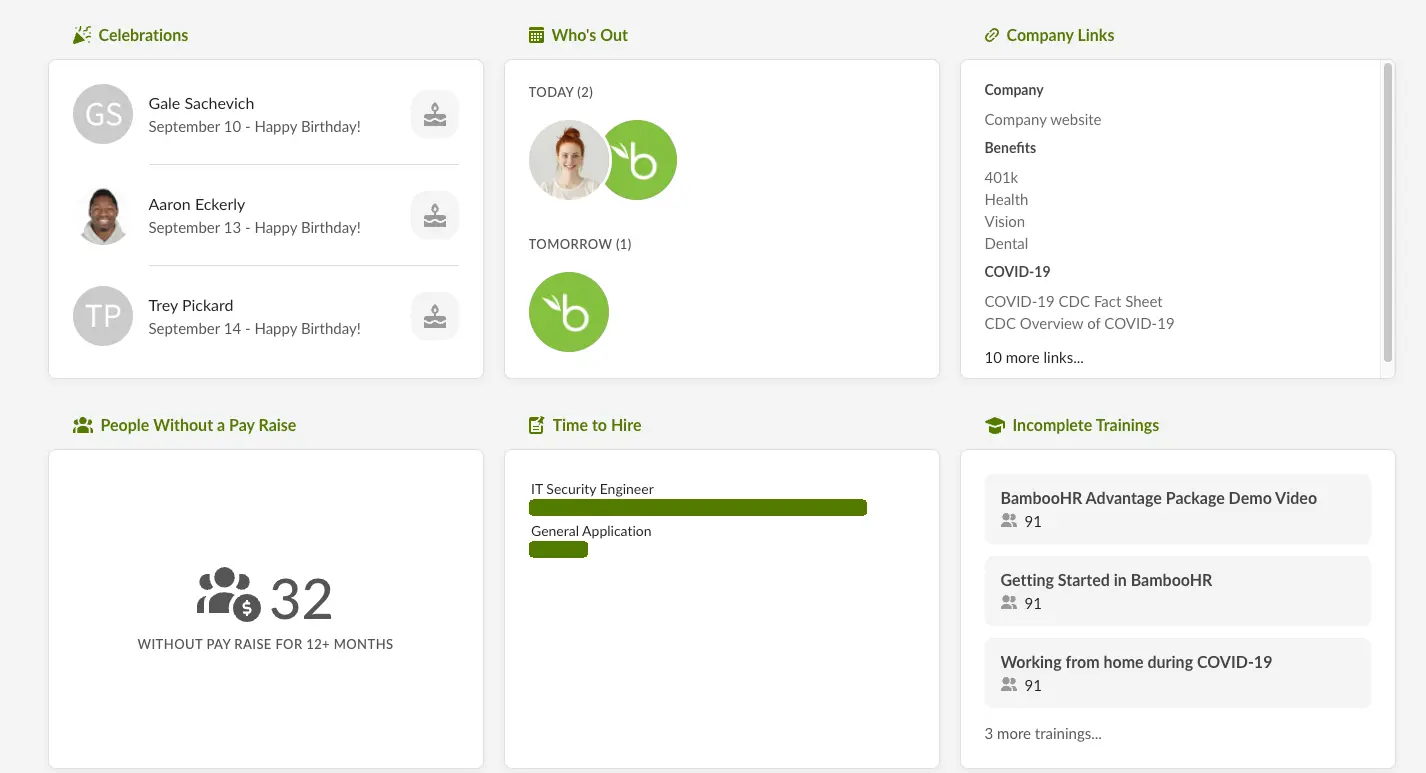
At its core, BambooHR is a system of record. One database holds employee information, time off, documents, and org structure. On top of that base, it adds a hiring module, a performance module, and optional paid add-ons for payroll and benefits administration.
BambooHR Features Review
BambooHR combines core HR, hiring, payroll, and performance tools into one login. However, each module performs differently when real teams use it daily. Below is our honest, feature-by-feature review of what each feature does well and where it begins to show its limits:
Core HR & Employee Database
Employee records, org charts, custom fields, and document storage are all in one searchable database. Employees can look up a colleague's contact details, see who reports to whom, and access their own payslips or tax documents without needing to email HR. This self-service feature saves a lot of time.
Our research found that users can update their own addresses, banking details, or emergency contacts. These changes go through an approval step instead of being silently overwritten. HR staff noted that this process has reduced the routine back-and-forth that used to take up their week.
Payroll
Salary calculations, deductions, tax management, and direct deposits all happen inside the Payroll module. Time-off and time-tracking data pull directly into pay cycles, which eliminates the manual reconciliation that used to consume every pay period.
BambooHR also partners with Remote to offer an Employer of Record service for international hires, handling payroll, benefits, and compliant employment contracts in countries where you don't have a legal entity.
Applicant Tracking & Recruiting
Every plan includes applicant tracking, though the Core tier limits how many jobs you can post at once. The module covers job posting, candidate pipelines, interview scheduling, and offer letters with e-signature, and it integrates with Indeed, ZipRecruiter, and Glassdoor.
For companies that need to post roles, collect applications, and move candidates through stages without buying separate recruiting software, it handles the basics only. However, it cannot resurface strong candidates from past roles when a similar position opens months later. That candidate data goes cold the moment a requisition closes, and you start sourcing from scratch every time.
Onboarding & Offboarding
New hires get digital checklists, e-signature for handbooks and policies, and a home page showing exactly what's left to complete. Several users liked adding personal touches, such as a new hire's favorite snack or hometown, to help the team connect before day one.
Offboarding replaces scattered email chains and PDF checklists with centralized, trackable task lists and automated reminders so nothing slips when someone leaves.
Benefits Administration
Enrollment, life-event changes, and eligibility rules all route through the Benefits Administration module. Once configured, the underlying engine manages multi-tiered accrual policies, tenure-based milestones, and location-specific rules without much manual intervention.
The initial setup is the bottleneck. Multiple users and our research found early confusion around how changes cascade through the system, so invest in getting the configuration right the first time.
Time Tracking & Attendance
This module covers two separate areas. Time-off and PTO tracking (leave requests, accrual balances, a shared calendar showing who's out) is part of the base plans. Time & Attendance (clock-ins, timesheets, overtime calculation) is a separate paid add-on.
Employees consistently praise the PTO module for making leave requests and balance checks effortless from any device. The one recurring gripe: leave balances aren't reduced until after those days are actually used, which makes it harder for managers to plan approvals with confidence.
Performance Management
Goal setting with sub-goals, peer feedback, self-assessments, manager reviews, and 360-degree feedback are all included in this module. It is built on customizable templates and is available starting with the Pro plan. This module works well for structured quarterly or annual review cycles.
However, it is less suited for teams that depend on frequent, informal 1:1 check-ins. Our research found that the options for scheduling and cadence in 1:1s feel limited compared to the formal review features.
Reporting & Analytics
Standard reports (turnover, headcount, time-off usage) work well. Custom reports are where friction shows up. Users across multiple platforms said they want deeper, more flexible breakdowns, particularly cross-tabulations of workforce data, and ultimately exporting to a spreadsheet to finish the job.
Navigation compounds the issue: opening an employee profile from a report loses your filters and sorting, forcing you to rebuild from scratch.
Mobile App & Ease of Use
Ease of use is BambooHR's most repeated compliment across every review platform. Most users report needing little to no training for either HR administration or daily employee tasks.
The mobile app is fast and reliable for approving requests, checking balances, and signing documents. Managers get a thinner experience on mobile, with team-level leave review leaning more heavily on the desktop version.
AI & Automation Tools
BambooHR's AI assistant, Ask BambooHR, answers employee questions about time-off balances, benefits enrollment, company policy, and platform navigation. It is available on the Pro plan and above. Users who engage with it appreciate the time they save when handling routine HR questions.
However, multiple users want more. They are looking for intelligent reporting, predictive analytics, and smarter workflow recommendations instead of just a policy chatbot. The feature works well within its current scope, but it’s not yet a differentiator.
BambooHR Pricing Review: Is It Worth the Investment?
Add-ons, priced via a custom quote, cover Payroll, Benefits Administration, Time & Attendance, and Employer of Record. Customers who bundle Payroll and Benefits Administration receive a 15% discount, which is rarely disclosed upfront.
The $10 headline rarely reflects actual cost. Add the modules that make BambooHR attractive, and the effective rate often lands between $16 and $30 per employee/month. A 100-person company on bare Core pays around $12,000 a year; the same headcount with Pro or Elite plus add-ons can reach $30,000 to $80,000 or more.
Sticker price and real price are different conversations. Get a full quote before comparing competitors, since modular alternatives like Greenhouse often close that gap once fully priced.
BambooHR Security and Compliance
BambooHR undergoes annual third-party SOC 1 and SOC 2 audits and commissions independent penetration testing. You can find the results and documentation at trust.bamboohr.com after signing an NDA. Customer data is hosted in data centers located in the U.S., Canada, or Ireland, depending on your location and applicable law.
The company's data processing agreement commits to maintaining records that align with ISO 27001 and SOC 2 standards. It also includes a GDPR data processing addendum for customers handling EU employee data. Role-based access controls allow you to restrict access to payroll, personal information, and other sensitive records.
One gap for larger organizations is that BambooHR is not listed on the FedRAMP marketplace. If you are a government contractor or agency with a FedRAMP requirement, this is a disqualifier. For everyone else, the security posture is solid and well-documented for an SMB-focused platform.
BambooHR Reviews: Pros & Cons
Below are the pros of BambooHR we identified through our research and cross-checked against verified user reviews:
- Easy to Learn, Minimal Training Needed: New employees and HR admins both pick it up quickly. This is consistently the most cited strength across every platform.
- Onboarding That Feels Personal: Digital checklists and e-signatures are standard. What users highlight is the ability to add personal details that help new hires feel welcomed, not just processed.
- Self-Service That Reduces HR’s Workload: Employees can update their own records, pull payslips, and request time off without calling HR. This feature is repeatedly noted as a real time saver.
- Strong Implementation Support: Multiple reviewers praised the hands-on help during the initial setup and data migration.
- A Real Hiring Module, Not a Bolt-on: Having an ATS built into the same system as employee records saves smaller teams from having to buy and integrate separate recruiting software.
Although BambooHR is widely used, our research and verified users reported these common limitations:
- Reporting Flexibility Has a Ceiling: Custom, cross-tabular, or specific reports often need to be exported to a spreadsheet.
- Add-on Costs Add Up Fast: Payroll, Benefits Administration, and Time & Attendance are separate from every tier. The true all-in cost is often much higher than the headline price.
- AI Features Are Still Basic: Ask BambooHR answers policy questions well but lacks the advanced reporting, screening, predictive insights, and workflow suggestions that users want.
- Customization Limits Show at Scale: Access permissions, review templates, and approval workflows become less flexible as the organisation grows.
- No Talent Rediscovery or Past-Applicant Resurfacing: When a requisition closes, candidates go cold. There’s no way to source or match past applicants to similar new openings later.
- Limited Screening Depth for High-Volume Hiring: The ATS tracks the pipeline well, but it doesn’t score or rank candidates against specific criteria. Recruiters have to manually evaluate every application.
How Integrating Skima AI Can Handle BambooHR's Limitations
BambooHR's ATS tracks active pipelines well, but our research and user reviews highlight that recruiters still have to manually screen every incoming application, candidate data goes cold once a role closes, and the platform doesn't score or rank applicants against role-specific criteria. Here's how Skima AI integration closes all three gaps:
- AI Candidate Screening: As applications come in BambooHR for a role, Skima AI automatically screens and ranks every candidate against the job's actual requirements, so recruiters open a prioritized shortlist instead of an unsorted queue to work through one by one.
- Database Rediscovery: Skima AI also scans your existing BambooHR candidate database and surfaces past applicants who match a new opening. Instead of sourcing from scratch for every opening, you start with qualified people who already showed interest.
- Explainable Match Scoring: Every candidate, new or rediscovered, gets a 0 to 100 score against the role, with specific reason bullets explaining why they matched. No black-box scoring.
- Skima Screened Tag: Candidates who clear the bar get tagged directly inside BambooHR, so hiring managers see who's worth a second look without re-reading every old application.
- Shortlist Feedback and Activity Notes: Hiring decisions and the reasoning behind those decisions are recorded in each candidate's BambooHR record. No more relying on a recruiter's memory or a separate spreadsheet.
Companies like Anaqua and BoxPower already use Skima AI integrated with BambooHR to save 67% of the time and budget spent on sourcing, screening, and hiring.
Who Is BambooHR Best For?
BambooHR is best for companies between 25 and roughly 1,000 employees that need one system for employee records, hiring, onboarding, and performance tracking without a dedicated IT team to manage it. Strong fit if:
- You're replacing spreadsheets and email chains, not migrating from another HRIS
- You need hiring, onboarding, and employee records in one login
- Your performance process follows structured review cycles
- You don't have (or want to hire) a full-time HR systems administrator
- Your payroll needs are U.S.-based
Who Should Avoid BambooHR?
The same simplicity that makes BambooHR appealing has clear limits. Avoid BambooHR and consider a different platform if:
- You've passed 500 to 1,000 employees with complex org structures, matrixed reporting, or multi-level approval chains
- You need native global payroll across many countries, not just an EOR add-on
- Your reporting needs go beyond standard headcount and turnover into custom workforce analytics
- You're a government contractor or agency with FedRAMP requirements
- You want deep AI-driven insights or predictive analytics in your core HR platform today
Final Verdict: Should You Buy BambooHR?
Yes, if you're a small or mid-sized company that wants one clean system for employee records, hiring, and onboarding, and you're willing to pay for add-ons separately. The core experience is easy to use, and that matters when you need an entire company to actually adopt new software.
Look elsewhere if you're scaling past 1,000 employees, need reporting depth beyond the standard set, or require native multi-country payroll. BambooHR was built for the company you are at 100 to 800 employees, not necessarily the one you'll be in three years if you're growing fast into more complexity than its current architecture handles.
Frequently Asked Questions
1. Is BambooHR legit?
Yes, BambooHR is a legit HR software platform. It has been operating since 2008, serving over 34,000 businesses, with independently audited SOC 1 and SOC 2 security controls.
2. Is BambooHR easy to use?
Yes, BambooHR is easy to use. It's the most repeated compliment across every major review platform. Most users report needing little to no training.
3. Does BambooHR have built-in ATS?
Yes, Applicant tracking is included on every plan, covering job posting, candidate pipelines, and e-signature offer letters, with a cap on active job openings at the Core tier.
4. Can BambooHR integrate with Skima AI?
Yes, BambooHR integrates with Skima AI through available integration points to enrich candidate data, auto-score applicants, and write tags or match insights back into candidate records to streamline recruiters' workflows.
5. Does BambooHR work for companies with 500+ employees?
BambooHR can work for companies with 500+ employees, but users at that scale consistently flag customization and reporting limits. Above 1,000 employees, evaluate enterprise-focused alternatives alongside BambooHR before committing.
6. Can BambooHR handle complex org structures?
Standard reporting lines and approval workflows work well. Matrixed or multi-layered structures hit real configuration limits as complexity increases.
7. What are the main disadvantages of BambooHR?
Disadvantages of BambooHR include limited custom reporting, add-on costs that exceed the headline price, AI features that are still basic, and support that feels less hands-on after the initial implementation.
8. Does BambooHR have a good employee database?
Yes, consistently one of the platform's best-reviewed features. Employees self-serve most of their own information, and HR gets a searchable, centralized record.
9. What does BambooHR cost per employee?
BambooHR costs $10/employee/month for the Core plan, $17 for Pro, and $25 for Elite. Payroll, Benefits Administration, and Time & Attendance are priced separately. The real all-in cost is often higher than the tier price alone.