
















- Platform Overview: SAP SuccessFactors is a Human Experience Management (HXM) suite that unifies core HR, recruiting, onboarding, performance, compensation, learning, and workforce analytics.
- Primary Features: Employee Central (core HR), SmartRecruiters for SAP SuccessFactors (recruiting), Onboarding, Performance and Goals, Compensation with Rewards and Recognition, Learning, Succession and Talent Intelligence, People Analytics, and the Joule AI assistant with expanding agentic capabilities.
- Starting Price: Pricing is quote-only and not published. My independent analysis estimates enterprise deployments around $150 to $250 per employee/year for the full suite, with module-based implementations starting lower.
- Best For: Large, global enterprises, typically 1,000 to 10,000+ employees, especially those already using SAP ERP or S/4HANA and needing deep multi-country payroll and compliance.
- Not Ideal For: Small or mid-sized companies, teams that want a modern, lightweight interface, or organizations that need fast implementation without a dedicated configuration partner.
- Integration: Teams integrate Skima AI with SAP SuccessFactors to screen new applicants, rediscover past candidates who fit new openings, and score every match with clear, explainable reasoning and compliance, all without replacing SuccessFactors.
In 2025, SAP acquired SmartRecruiters to improve its recruiting module. After this acquisition, SAP integrated SmartRecruiters with Employee Central and Onboarding, resulting in a unified hire-to-retire workflow, set to launch in its 1H 2026 release.
I evaluated the SAP SuccessFactors platform and every major feature, identified patterns from thousands of verified user reviews, and highlighted where SAP SuccessFactors meets expectations and where it slows recruiters down instead of helping them. Let's get started.
What Is SAP SuccessFactors?
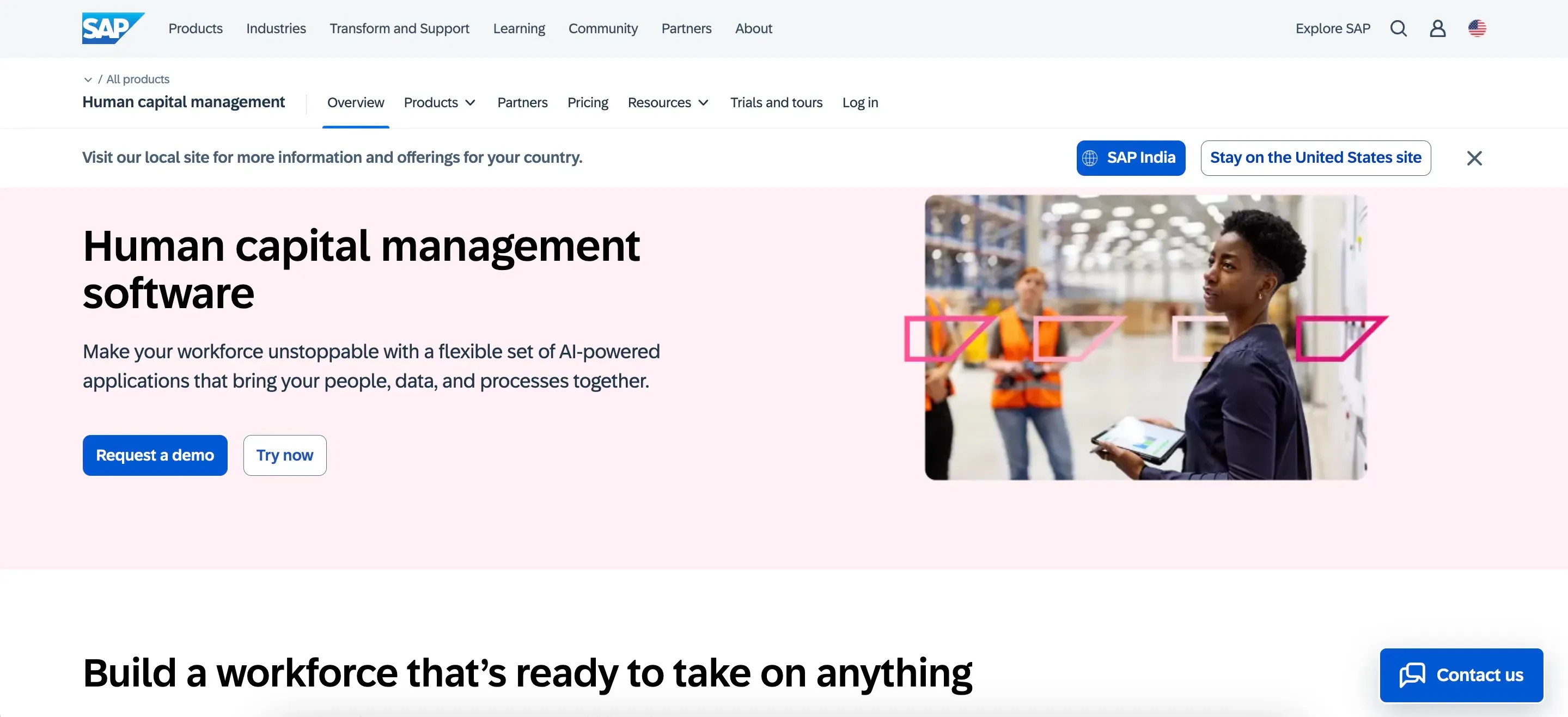
SAP SuccessFactors is a cloud-based Human Experience Management (HXM) suite that covers the entire employee lifecycle. This includes recruiting, onboarding, performance, compensation, learning, and offboarding. SAP acquired SuccessFactors as an independent company in 2012. It now operates as SAP's HCM product line, led by SAP CEO Christian Klein, rather than as a standalone business with its own chief executive.
The platform's clearest differentiator remains its deep native integration with SAP ERP and S/4HANA, since employee master data flows between systems without a separate integration project. SAP's 1H 2026 release delivered more than 400 individual innovations across the suite, with connected recruiting and the expansion of agentic AI as the two headline themes.
SAP SuccessFactors Features Review
SAP SuccessFactors organizes its product around Employee Central, its core foundation. On top of that, it includes Recruiting, Onboarding, Performance, Compensation, Learning, Succession, and People Analytics.
These modules are increasingly connected through Joule's expanding set of AI agents. Below is my honest evaluation of each feature, highlighting what it does well and where it still has limitations:
Employee Central (Core HR)
Employee Central holds the master employee record that every other module reads from. This includes organizational structure, position management, and global HR data across more than 100 countries.
I found that the single-source-of-truth design clearly pays off once a company has more than a few legal entities. A change in one place propagates everywhere, avoiding the need for a manual reconciliation project.
Self-service tools allow employees to update personal data, request time off, and view pay information without opening a ticket. Configurable workflows automatically route approvals.
However, there is a tradeoff in customization depth. Several core configuration tasks still require a certified implementation partner to work in the back-end provisioning client instead of an admin. This makes ongoing changes slower and more expensive than expected.
SmartRecruiters for SAP SuccessFactors
SAP's 2025 acquisition of SmartRecruiters replaced a legacy Recruiting module that had faced significant criticism. One user bluntly rated the old version a 5 out of 10, noting it did little more than post jobs reactively.
SmartRecruiters offers a modern applicant tracking system, configurable workflows, and an optional Winston conversational assistant. The 1H 2026 release finally connected SmartRecruiters natively to Employee Central and Onboarding, replacing its former bolt-on integration.
A new Interview Agent, also introduced in the 1H 2026 release, documents and screens interviews in the background. I see this as SAP's clearest signal yet that recruiting evaluation is shifting from a purely administrative task to an automated process.
However, this agent launched only months ago, and I have not yet found independent evidence of how consistently it performs at scale. Joule, SAP's broader AI assistant, still acts as a productivity tool within Recruiting. It drafts job descriptions and candidate messages, rather than serving as an evaluation engine that scores or ranks candidates.
Onboarding
A signed offer now automatically triggers onboarding tasks due to the improved SmartRecruiters connection. This change eliminates the manual handoff that used to occur between hiring and day-one preparation.
I found the day-zero portal, which gives new hires access to team introductions and digital paperwork before their start date, to be a significant improvement over a cold first morning.
Process orchestration goes beyond HR. IT is notified to provision hardware, and facilities prepares access badges. The same automation applies to internal moves, like promotions, not just external hires.
An update in the first half of 2026 added automated citizenship status workflows. This addresses a compliance step that previously required manual verification. The module works well once configured, but reaching that point relies on the same implementation expertise needed for the rest of the suite.
Performance & Goals
Continuous performance conversations go hand in hand with formal review cycles. Calibration tools allow managers to compare ratings across a team before finalizing them. This reduces the rating inflation that can occur when reviews happen in isolation.
I found the AI-assisted performance insights, now available for every review step type as of the 1H 2026 release, to significantly expand capabilities for organizations conducting collaborative or multi-step reviews.
New Goal Creation and Goal Progress agents help employees draft meaningful goals. They automatically flag goals if they drift out of alignment or become stale. Calibration alerts specifically target rating bias, highlighting patterns before a cycle closes rather than after the cycle closes.
The tradeoff appears in configuration complexity. Setting up calibration, competencies, and review templates correctly requires careful planning. A team that rushes this step may end up with a review process that seems structured but produces inconsistent ratings.
Compensation, Rewards & Recognition
FocalReview, the compensation planning engine, manages merit increases, bonus planning, and long-term incentives across various currencies and pay periods. This allows the compensation team to model different scenarios before sending recommendations for approval.
I found the ability to model different scenarios across matrixed management structures to be a real strength for a company with complex reporting lines.
Rewards and Recognition, an extension of the Spot Awards feature in Employee Central, provides managers and peers with a simple way to recognize good work outside the formal annual cycle. It is configurable enough that a Total Rewards team can maintain it without needing constant IT support.
Compensation modeling relies heavily on accurate underlying performance data, so inconsistent ratings elsewhere in the suite directly affect pay recommendations.
Learning
SAP SuccessFactors Learning includes compliance training, skills-based learning paths, and external content integrations all in one system. A Learning Compliance Agent, introduced in the 1H 2026 release, proactively prompts employees to complete required training before it becomes overdue.
I found the intelligent Q&A addition particularly useful. It answers specific questions based on a company's own course content, rather than making employees search through modules manually.
AI-driven course recommendations consider an employee's current role, stated goals, and identified skill gaps instead of offering a generic catalog. However, the learning module's interface feels less consistent than the rest of the suite. This inconsistency becomes noticeable when switching between Learning and Performance in the same session.
Succession & Talent Intelligence
The newer Talent Intelligence Hub enhances succession planning by incorporating skills governance and improved talent search. This allows companies to look for internal candidates based on custom attributes and competencies, rather than just job title or department.
I see this as a significant step toward viewing the existing workforce as a genuine sourcing pool for open roles, rather than merely an organizational chart for succession planning.
The addition of custom attributes as search criteria in the 1H 2026 release broadens the options for recruiters or managers when identifying internal talent for stretch assignments. This module is most effective when skills data is up to date. Companies that are still developing that taxonomy will find the search only as useful as the data that supports it.
People Analytics & Workforce Planning
People Analytics combines SAP Analytics Cloud with SuccessFactors data to create custom reports, headcount plans, and predictive workforce models instead of relying solely on pre-built dashboards.
I found the Story Reports builder to be quite powerful once a team understands its query structure. However, this complexity means that a company without in-house reporting skills often turns to external consultants for help.
A new feature in the first half of 2026, EU Pay Transparency Insights within People Intelligence, provides pay-gap analysis linked to the EU Pay Transparency Directive.
The directive’s requirements depend on national transposition and the obligations that apply to each employer. Integrating this regulatory perspective into the platform that holds the underlying compensation data is a significant advantage for a multinational company that would otherwise have to compile this analysis manually.
Joule & Agentic AI
Joule, SAP's AI assistant, now covers the entire suite with natural-language navigation and a growing list of specialized agents instead of just one general-purpose chatbot.
The 1H 2026 release alone introduced a Pending Workflow Agent that nudges approvers to act on stalled tasks, an RBP Agent that creates permission roles from natural-language descriptions, and an Integration Agent that automates field mapping and flags integration errors before they lead to downstream issues.
I see this agent-by-agent rollout as a deliberate strategy. Instead of one large release, SAP is delivering narrow, task-specific agents on a monthly basis, allowing each one to develop independently. Galileo, a newer addition, highlights HR best practices based on Josh Bersin's research rather than offering generic suggestions.
The tradeoff is coherence. With so many discrete agents launching on staggered timelines, a company adopting SuccessFactors today is using a suite where some AI capabilities are mature while others are only months old. Keeping track of which is which requires close attention from an IT or HRIS team.
SAP SuccessFactors Pricing Review
SAP does not publish SuccessFactors pricing anywhere. Each quote is based on a subscription model priced per employee per year. The cost varies depending on the modules a company selects. To get an exact price, a sales conversation is necessary.
Independent estimates suggest that a full-suite enterprise deployment costs between $150 and $250 per employee per year. Smaller, module-based implementations start around $50 to $80 per employee per year for a narrower scope.
Implementation costs are a separate and often significant expense. Full-suite rollouts usually take 9 to 18 months and can cost as much as the first year of software fees. This is especially true when a company needs a certified partner for back-end configuration that cannot be managed internally.
Treat every figure here as directional since SAP has not confirmed pricing publicly. Request a quote that includes every module your organization plans to use, along with a realistic implementation timeline, before comparing the total against a competitor like Workday.
SAP SuccessFactors Marketplace
SuccessFactors Marketplace integrates natively with the broader SAP ecosystem, including S/4HANA, SAP Business Technology Platform, and SAP Analytics Cloud. It also features a partner network with over 300 third-party solutions for specialized needs.
I consider this SAP-native integration path to be the platform's clearest advantage for companies already using SAP for finance or operations. Employee data flows seamlessly without requiring a custom-built connector.
The 1H 2026 release also expanded application extensions specifically for SmartRecruiters. This allows partners to build directly on the newly connected recruiting flow rather than work around it.
For companies without other SAP products in place, this level of integration is less important. In such cases, the broader, more general-purpose marketplace offered by some competitors may be a better fit for a mixed, non-SAP technology stack.
SAP SuccessFactors Security and Compliance
SuccessFactors supports payroll and HR compliance in over 100 countries and territories. It includes built-in legal and regulatory updates that automatically reflect changes in local requirements, eliminating the need for manual patches.
Role-based permissions are now easier to configure through the natural-language RBP Agent. The agent controls who can view or act on sensitive employee and candidate data.
The addition of EU Pay Transparency Insights specifically helps ensure compliance with the EU Pay Transparency Directive. Automated citizenship status workflows in onboarding address a documentation requirement for which verification was previously manual.
For companies with sector-specific compliance needs that go beyond what is publicly documented, those discussions should be directed to SAP's sales and legal teams. The scope of certifications varies by region and deployment.
SAP SuccessFactors Reviews: Pros & Cons
Based on my evaluation and cross-referencing verified user reviews, these are the standout pros of SAP SuccessFactors:
- Native SAP Ecosystem Integration: Users consistently cite seamless data flow with S/4HANA and other SAP applications as the platform's clearest advantage for companies already standardized on SAP.
- Genuine End-to-End Coverage: Verified users describe managing the entire employee lifecycle, from hire through retire, in one connected system as a real reduction in duplicate data entry across separate tools.
- Strong Multi-Country Payroll and Compliance: Users in regulated industries and complex global structures specifically credit SuccessFactors with handling multi-country payroll and local labor law variation better than lighter alternatives.
- Capable Reporting for Technical Users: Multiple Users describe building detailed ad hoc reports and dashboards without waiting on IT once they understand the platform's query structure.
- Continuous, Meaningful AI Investment: Verified users note steady feature releases across Joule and the newer agent rollout rather than a platform that stagnates between major versions.
Despite these strengths, the same users reported several cons of SAP SuccessFactors that you should be aware of:
- Steep Learning Curve and Configuration Dependency: Users reported needing extensive training to navigate the platform. Several core configuration tasks still require a certified partner instead of an internal admin.
- Inconsistent Interface Across Modules: Multiple users specifically note that the experience shifts noticeably when moving between Learning, Performance, and other modules. It does not feel like one unified product.
- Dated User Experience Compared to Newer Competitors: Several users describe the interface as outdated compared to platforms like Workday, despite steady backend improvements.
- Slow, Costly Implementation: Users consistently report rollouts taking 9 to 18 months. Implementation costs often match or exceed the first year of subscription fees.
- Basic Candidate Matching: Before the SmartRecruiters integration, users rated the legacy recruiting module's matching capability as little more than reactive job board posting.
- No Native Talent Rediscovery Across the Full Database: Candidates who applied for a past role and were not hired do not automatically resurface for a new, similar opening. This gap predates the SmartRecruiters acquisition and has not yet been shown to be resolved.
How Integrating Skima AI Can Handle SAP SuccessFactors's Limitations
SAP SuccessFactors does not provide a candidate scoring and ranking engine. Also, candidates who applied to a past role and were not hired do not automatically get rediscovered for a new, similar opening. To address these limitations, teams integrate Skima AI without the need to replace SAP SuccessFactors or SmartRecruiters. Here is what the integration provides:
Here is what the Skima AI integration provides:
- Job Description Compliance Check: Before a requisition goes live, Skima AI flags gender or age-coded language, audits inflated requirements that could indirectly exclude protected groups, and confirms a compensation range is included where local law requires it, catching exposure at the source instead of after applications start arriving.
- AI Candidate Screening: As candidates apply for a job synced from SAP SuccessFactors, Skima AI screens and ranks each resume against the role's actual requirements automatically, so a recruiter opens a prioritized shortlist instead of an unsorted queue of applications to evaluate one by one.
- Talent Rediscovery for Past Candidates: Skima AI scans a company's existing SuccessFactors database for candidates who were screened before but never hired, surfacing qualified matches for a brand-new opening without a recruiter having to build a fresh search from scratch.
- Explainable Match Scoring Behind Both: Every score comes with a written reason based on specific skills, years of experience, and certifications, rather than an opaque ranking, so a recruiter or hiring manager can see exactly why a candidate ranked where they did.
Who Is SAP SuccessFactors Best For?
SAP SuccessFactors is best for large, global enterprises that need comprehensive multi-country compliance and seamless integration with existing SAP systems. It is ideal for organizations using SAP ERP or S/4HANA. This solution suits those operating in over 100 jurisdictions and employing more than 1,000 staff.
It is also ideal for companies with dedicated HRIS or IT teams that require complete hire-to-retire solutions. Additionally, it appeals to organizations that value a vendor committed to AI advancements, such as Joule's agents and SmartRecruiters integration.
Who Should Avoid SAP SuccessFactors?
The depth and global compliance coverage that make SuccessFactors valuable for large enterprises become unnecessary overhead for simpler needs. Avoid SAP SuccessFactors if:
- You are a small or mid-sized company without the budget or team to support a 9 to 18 month implementation
- You want a modern, consistently designed interface rather than one that shifts noticeably between modules
- You do not operate other SAP products and would gain little from the platform's native SAP ecosystem integration
- You need internal administrators to handle configuration changes rather than depending on a certified implementation partner
- You need mature, proven AI-driven candidate screening today rather than agents that launched only months ago
Final Verdict: Should You Buy SAP SuccessFactors?
I recommend SAP SuccessFactors for large global enterprises, particularly those using SAP ERP. It offers genuine multi-country compliance but requires a commitment to implementation and training.
The SmartRecruiters acquisition and its 1H 2026 integration address a longstanding gap, while the gradual AI rollout across Joule indicates a careful approach rather than a rushed release.
However, if a team needs a quick, lightweight implementation or a modern interface, I’d suggest looking elsewhere. For immediate AI-driven candidate screening and explainable match scoring, integrating Skima AI with existing SuccessFactors and SmartRecruiters setups is a more practical choice than waiting for the Interview Agent to mature.
Frequently Asked Questions
1. What is SAP SuccessFactors?
SAP SuccessFactors is a cloud-based Human Capital Management (HCM) suite. It covers core HR, talent management, recruiting, learning, payroll integrations, and workforce analytics. It’s mainly designed for medium-to-large organisations with global compliance needs.
2. What are the key features of SAP SuccessFactors?
It offers modular HCM capabilities like Employee Central, Recruiting, Performance & Goals, Learning, Succession, payroll integrations, and embedded analytics. These features enable centralised HR processes, talent development, and global compliance for enterprise use.
3. How much does SAP SuccessFactors cost?
Pricing is based on quotes. It varies by modules, user counts, and implementation complexity. Organisations need to contact SAP sales for custom pricing per user, module, or enterprise contract.
4. Can SAP SuccessFactors integrate with other HR or recruiting tools?
Yes, SuccessFactors supports API-based integrations, middleware, and SAP connectors. This allows data synchronisation with ERPs, payroll systems, LMS platforms, and third-party recruiting or analytics tools for seamless workflows.
5. How does integrating Skima AI with SAP SuccessFactors help recruiters?
Integrating Skima AI with SAP SuccessFactors provides explainable candidate scoring, automated resume parsing, and prioritised shortlists through API sync. This reduces screening time, improves shortlist quality, and boosts recruiter efficiency while keeping SuccessFactors’ enterprise HR structure.