















Teamtailor is a cloud-based ATS built around employer branding, combining a drag-and-drop career site builder, candidate relationship management, and an AI Co-pilot in one recruitment workspace.
- Primary Features: Applicant tracking and hiring pipelines, career site and employer branding tools, candidate relationship management and sourcing, AI Co-pilot, recruiting analytics, and a 450+ partner integration marketplace.
- Starting Price: Pricing is quote-only; third-party buyer data points to roughly $199 per month at the entry level, climbing with headcount and job volume into the low thousands per month for larger teams.
- Best For: Small to midsize companies (roughly 0-5,00 employees) that want employer branding built into the ATS, plus enterprise teams operating a global, multilingual hiring process.
- Not Ideal For: Staffing and recruiting agencies that need deep CRM and multi-client workflows, high-volume hiring teams processing 500+ applications a week, or teams that need granular custom reporting out of the box.
- Integration: Users integrate Skima AI with Teamtailor to screen new applicants, resurface past candidates who fit new roles, and score every match with clear, explainable reasoning, all without replacing Teamtailor.
Teamtailor built its entire product around employer branding, integrating a career site editor directly into the ATS rather than offering it as a separate add-on. That design suits companies competing hard on candidate experience. However, it is not ideal for staffing agencies that manage multi-client CRM workflows or teams handling high volumes of applications.
Our research team invested over 60 hours evaluating Teamtailor's features and AI capabilities. We reviewed verified user feedback and cross-checked every claim against the platform's current product. We also identified where Teamtailor shines and where teams face genuine challenges or consider integrations to fill the gaps.
What Is Teamtailor?
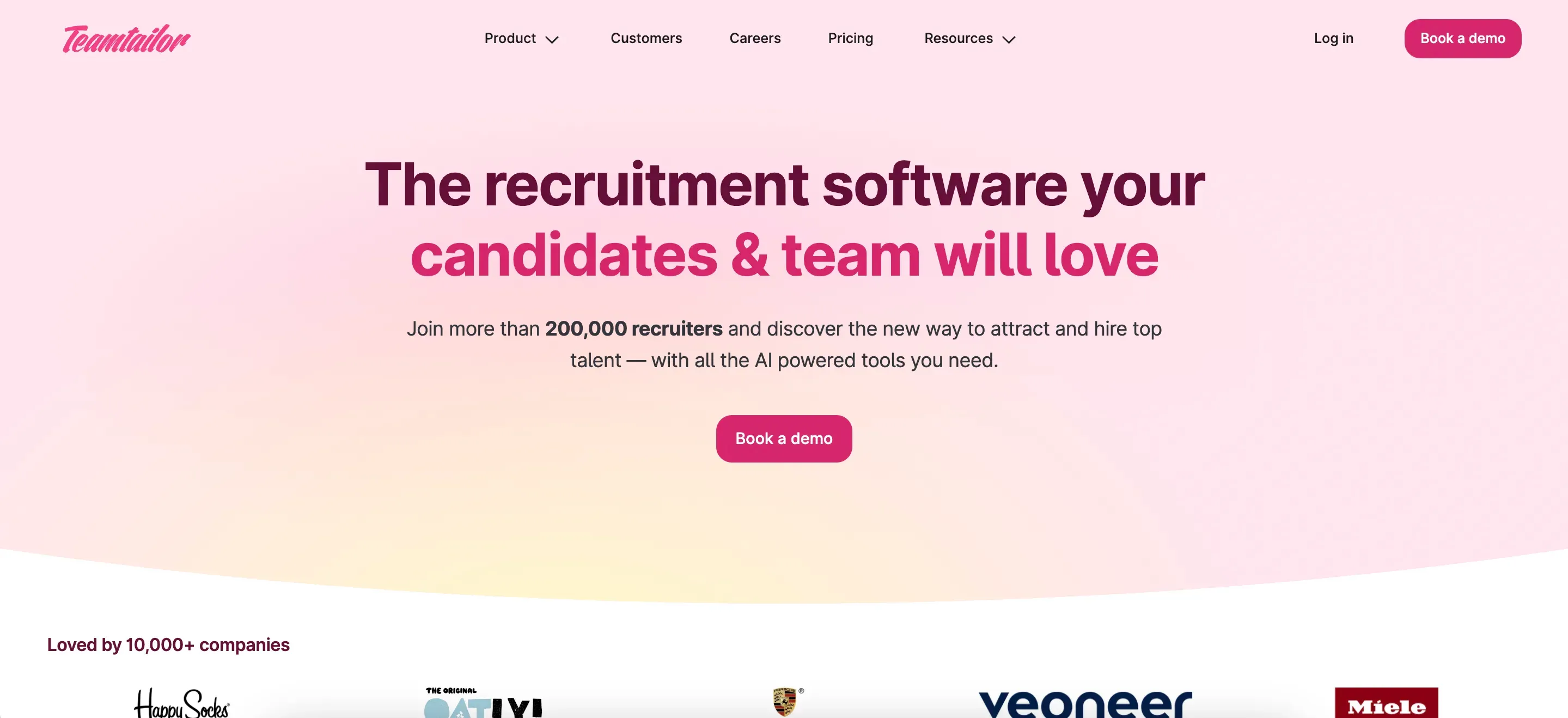
Teamtailor is a Swedish recruitment platform that combines a standard applicant tracking system with a career site builder and employer branding tools, positioning the candidate experience as central to the product rather than an add-on. Co-founder Erik Andersson still leads the company today, more than a decade after Teamtailor launched out of Stockholm.
Teamtailor Features Review
Teamtailor organizes its product around four core solutions: the applicant tracking system, employer branding and career sites, candidate relationship management, and the AI Co-pilot. It also includes collaboration tools and analytics layered across all of them. Below is an honest, feature-by-feature evaluation of what each module does well and where it shows its limits:
Applicant Tracking & Hiring Pipeline
Job ads, candidate pipelines, and interviews all exist on one shared Kanban-style board for recruiters and hiring managers. Triggers automate the repetitive parts of the hiring process. They move candidates between stages, send scheduling links, and send status emails without requiring manual input from recruiters.
A smart-scheduling tool allows candidates to choose interview times without the usual back-and-forth, eliminating a whole round of coordination emails. The interface is the easiest part of switching to Teamtailor. However, bulk actions for large candidate batches, like rejecting or messaging hundreds at once, still feel limited compared to more established enterprise ATS platforms.
Employer Branding & Career Site Builder
A drag-and-drop career site is included with every Teamtailor account. It shares the same data model as the ATS, so a new job ad appears on the career page as soon as it's published. Recruiters can configure logos, fonts, colors, and layout without developer assistance. They can also create unlimited campaign or location pages for specific teams, cities, or hiring initiatives.
Career sites support multiple languages and connect to WhatsApp, candidate chat, and referral tools. This keeps passive candidates engaged before they apply. This module serves as Teamtailor's strongest competitive advantage among ATS platforms in its class. It's the reason a career-site-first buyer would choose it over a similar tool that treats the careers page as an afterthought.
Candidate Relationship Management & Sourcing
Candidates who apply, get referred, or opt into Connect all enter a searchable talent pool. This pool acts as a lightweight CRM layered on top of the ATS. Nurture email campaigns keep passive candidates engaged for future openings. A browser sourcing extension allows recruiters to add candidates found on LinkedIn or elsewhere directly into the pipeline.
Segmentation and tags enable a team to build targeted talent pools based on skill, location, or interest area. This approach avoids treating the entire database as a single list. Compared to a purpose-built staffing CRM, this module covers the basics well but lacks deeper sourcing tools like sequence automation or scaled outbound campaigns.
Collaboration & Hiring Manager Tools
Hiring managers are directly involved in the process instead of relying on a spreadsheet export or an email thread. A dedicated hiring team view allows managers to rate and comment on candidates alongside recruiters. Tagging a teammate on a candidate card keeps feedback linked to the record instead of scattered across inboxes.
External recruiters and staffing partners can be invited as limited-access collaborators without a full paid seat. An employee referral dashboard enables staff to submit and track referrals within the same system. Access can be restricted by hiring stage or by candidate, but the underlying permission model relies on a small set of pre-built role templates rather than fully custom rules.
AI Co-pilot
Co-pilot drafts job ads and interview questions, summarizes resumes and video-interview recordings. It also drafts candidate emails, such as rejections and offers, all from the same screen a recruiter already uses. Additionally, it flags top applicants as they apply and suggests existing candidates from the talent pool who match a new opening.
The writing assistance feature saves time on repetitive drafting tasks. However, the candidate matching feature can be inconsistent, so a manual review is still necessary before trusting a shortlist.
Recruiting Analytics & Insights
Dashboards cover job performance, audience traffic to the career site, team activity, and the entire recruitment funnel, including time-to-hire and NPS surveys sent to candidates and clients. Custom reports allow teams to create their own filtered views instead of relying solely on pre-built templates.
Additionally, a BI connector is available for teams that want to pull Teamtailor data into their own reporting stack. The standard dashboards are good for a quick check, but for anything more advanced, especially detailed EEO or DEI reporting, a workaround or export to a spreadsheet is needed to achieve real analytical depth.
Teamtailor Pricing Review: Is It Worth the Investment?
Teamtailor does not publish pricing anywhere on its site. The pricing page states that every quote is custom, based on company size and hiring volume, and every plan includes unlimited job postings, unlimited users, and access to the full integration marketplace.
Getting an actual number means booking a demo and talking to sales, since there's no self-serve checkout or published tier structure to compare against competitors upfront.
Independent buyer data offers some directional sense of cost, though Teamtailor hasn't confirmed any of it. One pricing tracker cites contracts starting around $199 a month for small teams and climbing past $500 a month once a company grows past roughly 150 employees, with custom quotes required above 250 employees.
A separate analysis of buyer-reported data puts the average annual contract around $16,500 to $17,000, with renewal increases in the 3% to 8% range baked into many agreements. Treat all of these as estimates rather than confirmed figures until a quote is in hand.
Teamtailor Marketplace
Teamtailor Marketplace connects with over 450 partners, including job boards, assessment providers, background-check services, video interviewing tools, HRIS platforms, and e-signature solutions.
The LinkedIn integration works in two ways: candidates can use Apply with LinkedIn, and recruiters can sync through LinkedIn Recruiter System Connect. Additionally, a Zapier connection expands access to hundreds of apps beyond the built-in list.
The Promote Team option automatically distributes job ads to job boards. A public, JSON API-based API allows technical teams to create custom connections that the marketplace doesn't already support. For teams comparing Teamtailor to a point-solution stack, this marketplace highlights the benefits of using one platform instead of combining multiple tools.
Teamtailor Security and Compliance
Teamtailor holds SOC 2 and ISO 27001 certification, which is displayed on its site along with a dedicated trust center that provides more details about its security posture. GDPR tools include consent checkboxes at the application stage, automatic deletion of candidate data based on company-set rules, audit logs of system activity, and a public list of sub-processors for customers in the EU region.
Candidates also have access to a self-service data and privacy center where they can view or request the removal of their information. For companies with strict data residency or audit requirements beyond these certifications, discussions should be directed to Teamtailor's sales and trust teams, as this information is not published in detail on the marketing site.
Teamtailor Reviews: Pros & Cons
Based on our evaluation and verified user reviews across trusted review platforms like G2, Capterra, and more, here are the standout pros of Teamtailor:
- Ease of Use Out of the Box: New recruiters and hiring managers alike describe the interface as intuitive enough to skip formal training, a point that comes up more than any other in reviews.
- Career Site as a Genuine Differentiator: Users consistently name the drag-and-drop career site builder as the reason they chose Teamtailor over a competing ATS.
- Responsive, Hands-on Support: Dedicated account managers and fast live chat responses are praised repeatedly as a reason implementation went smoothly.
- Automation That Actually Gets Used: Triggers for candidate communication and stage movement show up often as a genuine time-saver rather than a feature that nobody touches.
- Strong Candidate Experience: Customers across company sizes say candidates comment positively on how the application and communication process feels.
Despite these strengths, the same user reviews reported several cons of Teamtailor that you should be aware of:
- Inconsistent AI Matching: Multiple users describe Co-pilot's candidate-matching and screening suggestions as unreliable, saying they still review every application manually rather than trusting the AI's shortlist.
- No Rediscovery of Past Applicants: Candidates who applied for earlier roles don’t automatically appear for similar new openings. Also, duplicate profiles from repeat applicants need manual merging.
- Reporting Depth Has a Ceiling: Custom and DEI-specific reports often require a workaround or an export to a spreadsheet for deeper analysis.
- Not Built for High-Volume Hiring: Teams processing 500 or more applications a week describe the pipeline as slow, with limited bulk actions compared to enterprise-grade ATS platforms.
- Limited CRM Depth for Agencies: Users from staffing-specific tools found the built-in CRM functional but shallow compared to dedicated sourcing and client-management platforms.
How Integrating Skima AI Can Handle Teamtailor's Limitations?
Teamtailor's Co-pilot flags top applicants as they arrive, but several users still review every application manually because the AI's suggestions don't consistently hold up, and past candidates who already applied for a similar role do not get resurfaced automatically.
However, users connect Skima AI with Teamtailor to close these gaps seamlessly. Here's what the integration provides:
- AI Candidate Screening for New Applicants: As candidates apply to a job synced from Teamtailor, Skima AI evaluates each resume against the role's actual requirements and ranks the pool automatically, so a recruiter opens a prioritized shortlist instead of reviewing every application by hand.
- Talent Rediscovery for Past Candidates: Skima AI scans a company's existing Teamtailor database for people who applied or got screened before but were never hired, surfacing qualified matches for a brand-new opening without a recruiter starting from scratch.
- De-Duplication and Profile Enrichment: Skima AI automatically merges duplicate candidate records, matched by email, phone, LinkedIn URL, or a combination of name, location, and company, and fills in missing profile fields from context, so the database stays clean instead of accumulating the same repeat applicant under multiple entries.
- Explainable Match Scoring Behind All Three: Every score comes with a written reason verified from specific skills, experience, and certifications, rather than a black-box number, so a recruiter or hiring manager can see exactly why a candidate ranked where they did.
Who Is Teamtailor Best For?
Teamtailor is best for small to midsize companies, typically those with 0 to 5,00 employees, that want employer branding and a career site integrated with their hiring pipeline, rather than added separately. Enterprise teams that operate in multiple countries and languages also find it a good fit.
Teamtailor offers a dedicated enterprise product line in addition to its small-to-midsize options. Companies undergoing a rebrand or those that rely heavily on their careers page to attract talent usually gain the most from the platform's key features.
Who Should Avoid Teamtailor?
Avoid Teamtailor if you're a staffing and recruiting agency that needs deep client relationship management, multi-entity job orders, and agency-specific billing workflows. You may be better served by a dedicated staffing CRM, since Teamtailor's CRM layer is built for in-house teams rather than agency desks.
Additionally, teams hiring at high volume, 500 or more applications a week, should consider the slowdown in the pipeline and the limited bulk actions that occur at that scale. Companies that need advanced, ready-made DEI or custom analytics, without the need to create their own reports, should also carefully evaluate whether Teamtailor's native reporting provides enough depth before making a commitment.
Final Verdict: Should You Buy Teamtailor?
Yes, Teamtailor is ideal if employer branding and candidate experience are central to your hiring strategy and you're a small to midsize company or a multi-country enterprise that wants that branding built into the ATS itself rather than managed through a separate tool. The career site alone justifies the switch for teams that have struggled to get design or engineering teams to update a careers page.
However, consider Teamtailor alternatives if your business depends on staffing-agency workflows, processes hundreds of applications a week, or needs analytical depth that a spreadsheet workaround cannot provide.
Frequently Asked Questions
Is Teamtailor an all-in-one recruiting platform?
Yes, Teamtailor combines applicant tracking, a career site builder, candidate relationship management, and an AI Co-pilot in one system rather than requiring separate point solutions for each.
What is Teamtailor used for?
Companies use Teamtailor to post jobs, build a branded career site, track candidates through a hiring pipeline, and communicate with applicants from one platform.
Does Teamtailor have AI features?
Yes, its AI Co-pilot summarizes resumes and interviews, and suggests candidate matches. However, verified users reported inconsistent matching accuracy, enough to require a manual check before trusting a shortlist. To address this, most users integrate Skima AI.
How much does Teamtailor cost?
Teamtailor doesn't publish pricing. Every quote is custom based on company size and hiring volume, and third-party buyer data suggests entry-level contracts start around $199 a month.
Does Teamtailor integrate AI screening?
Teamtailor integrates with AI screening tools like Skima AI to add automated resume parsing, candidate scoring, and match insights. This enhances prioritization, reduces manual screening, and preserves existing ATS workflows.
Is Teamtailor good for small businesses?
Yes, Teamtailor built a dedicated product line for companies with 0 to 5,000 employees, and the setup is light enough for teams without a dedicated recruiting operations function.
Is Teamtailor good for staffing or recruiting agencies?
Not particularly, Teamtailor’s candidate relationship management tools are built for in-house hiring teams, and agencies needing deep client management typically look at dedicated staffing CRMs instead.
Does Teamtailor work for high-volume hiring?
No, the pipeline slows down and bulk actions stay limited once a team processes 500 or more applications a week, compared to enterprise-focused ATS platforms.