














Paylocity is a cloud-based HCM platform that unifies payroll, HR, talent management, time and labor, benefits, and finance and spend management into a single system.
- Primary Features: Payroll, recruiting and applicant tracking, talent management (performance, compensation, learning), onboarding, time and labor, benefits administration, spend management, reporting and analytics, and an expanding AI layer that now includes Ignite AI.
- Starting Price: Pricing is quote-only and not published. Independent buyer data estimates the full HCM suite in the $22 to $32 per employee/month range, with payroll-only configurations starting lower.
- Best For: Mid-market companies between roughly 50 and 5,000 employees, especially those with distributed or high-turnover workforces in retail, hospitality, and healthcare that want payroll, HR, and finance consolidated under one login.
- Not Ideal For: Small businesses under 50 employees with simple payroll needs, companies that need deep multi-country global payroll, or organizations that want fully transparent pricing without a sales conversation.
- Integration: Recruitment teams integrate Skima AI with Paylocity to screen new applicants, rediscover past candidates who fit new openings, and rank every match with clear, explainable reasoning, all without replacing Paylocity.
Every HR leader eventually confronts the same tradeoff: build a stack from best-of-breed point solutions, or commit to one platform broad enough to cover payroll and HR, and increasingly finance and IT.
Paylocity has spent the last two years making an aggressive case for the second path, most notably through its 2024 acquisition of spend management platform Airbase and, this past April, its acquisition of AI recruiting automation company Grayscale Labs.
That expansion means you need to know whether breadth comes at the cost of depth in any single module. I evaluated every core Paylocity product, tracked Paylocity's recent AI and acquisition updates, and identified patterns from thousands of verified user reviews to find out where it excels and where you may need external integrations. Let's get into it.
What Is Paylocity?
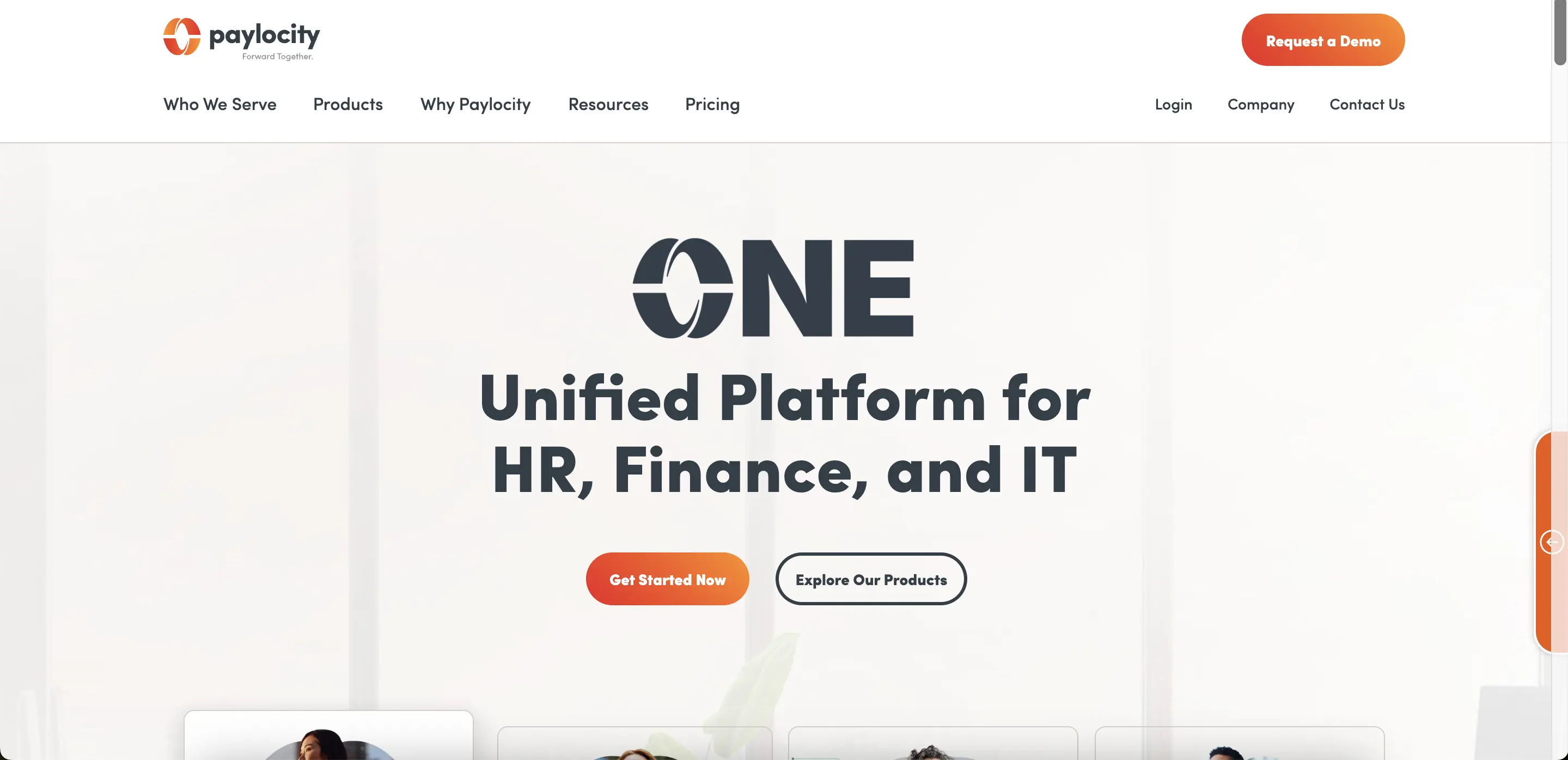
Paylocity is a cloud-based Human Capital Management (HCM) platform that unifies HR, payroll, talent management, and, more recently, finance and IT operations into a single connected system. Founded nearly three decades ago, the company went public on NASDAQ in 2014. Toby Williams is its current President and CEO.
Additionally, Paylocity established itself as one of the first HCM vendors to integrate generative AI directly into its product. It has maintained this momentum with a series of acquisitions and product launches in 2025 and 2026. These developments expand Paylocity beyond its payroll origins into recruiting automation and finance operations.
Paylocity Features Review
Paylocity organizes its product around payroll, talent management, time and labor, benefits, and (since the Airbase acquisition) spend management, with an AI layer and a reporting suite that enhances them all. Below is my honest, feature-by-feature evaluation of what each one does well and where each one still has limitations:
Payroll
Paylocity's payroll engine automatically handles tax calculations, direct deposits, wage garnishments, and year-end filings, including W-2 and 1099 forms, across federal, state, and local jurisdictions. QuickPay allows an admin to process an off-cycle check in minutes, with time and attendance data feeding directly into pay cycles.
The module earns its reputation in multi-state compliance. Tax codes and filing requirements update automatically as they change, which is crucial for any company processing payroll across multiple states. I found the accuracy consistently solid, and it aligns with what stands out as the platform's most reliable function.
However, support for international contractors and multi-country operations remains relatively limited, so companies with a large global workforce often pair Paylocity with a dedicated global payroll partner.
Recruiting & Applicant Tracking
Job postings automatically distribute to over 20,000 boards, including LinkedIn, Indeed, Glassdoor, and Monster. A branded career site ensures the candidate experience aligns with the company identity. Candidates can apply by texting a keyword or scanning a QR code. One-way video interviews and self-scheduling eliminate a round of back-and-forth coordination.
Every candidate record, communication, and evaluation is kept in one profile, from the offer letter to e-signature. Background checks are managed through a partnership with Checkr. A January 2025 update targeted high-volume hiring and EEO compliance, adding tools that help recruiters evaluate applications faster without cutting corners.
What Paylocity has historically lacked is automatic candidate matching at scale. This gap is being addressed by its April 2026 acquisition of Grayscale Labs, whose technology targets AI-driven engagement designed for high-volume hiring. I'd consider that AI-matching capability still expanding rather than fully mature today.
Talent Management: Performance, Compensation & Learning
Performance reviews go through customizable cycles. I found the workflow useful once a manager completes a review. It flows directly into Compensation and triggers a raise recommendation with a built-in approval chain. This means nobody has to re-key numbers into a separate spreadsheet.
Compensation relies on Market Pay, which switched to Salary.com as its data source in an April 2026 update. This change gives compensation teams access to solid external benchmarks without leaving the platform, which matters when a manager needs to justify an offer to finance.
Learning rounds out the module. Courses are assigned automatically as soon as onboarding starts. AI-driven recommendations now match training to an employee's career goals. I noticed a significant increase in course completions since this feature was introduced.
What ties the three together is the shared employee record, and that is the real strength here. My concern is about flexibility. The review-to-compensation handoff works well within Paylocity's built-in workflow. However, a process that deviates even slightly can be difficult to adjust.
AI Assistant, Ignite AI & Automation
Paylocity was the first HCM vendor to embed generative AI in 2023 and has been expanding since then. The AI Assistant now goes beyond answering questions; it can take direct action, a change that started in September 2025. Its acquisition of Grayscale Labs in April 2026 added engagement automation for high-volume hiring.
Ignite AI, launched this July, took things further with specialized agents: Answer & Insight for natural-language queries, Payroll Analysis for anomaly detection, and Candidate Fit for evaluating applicants against role requirements.
Each agent works independently rather than as a connected system. Candidate Fit ranks an applicant but doesn't provide the evidence behind the ranking, so a recruiter cannot see why one applicant scored higher than another. This lack of transparency now matters because of requirements under the EU AI Act and NYC Local Law 144.
Moreover, Grayscale speeds up the process for new applicants but does not search the database for past candidates who match a new opening. This gap, along with a database that goes inactive once a role closes, is why recruiting teams still use external AI tools alongside Paylocity's offerings.
Onboarding & Core HR Records
A signed offer letter triggers Paylocity's digital onboarding flow. This reminds new hires to complete their paperwork, tax forms, and I-9 documentation before their first day. E-Verify integration and configurable document rules vary by state and role, reducing the back-office scramble associated with manual compliance tracking.
Employee records, org charts, and document storage are all housed in the same database into which onboarding feeds data. This allows a new hire's information to carry over without requiring anyone to re-enter it.
Self-service access enables employees to view pay stubs, update personal details, and check org charts without having to open an HR ticket. However, there is a data-consistency gap. A supervisor change in HR does not always update in Time & Labor or Expense, so admins sometimes have to update the same field twice..
Benefits Administration
Employees navigate open enrollment using integrated cost breakdowns and plan comparisons. Paylocity's data shows that this type of guided support significantly boosts enrollment participation. Life-event changes, dependent updates, and carrier connections all go through the same interface. Payroll deductions sync automatically once a plan selection is confirmed.
I found the mobile experience for checking claims and balances consistently convenient. It stands out as one of the platform's stronger self-service features. However, the module can feel limited for companies with less common plan structures.
Specific benefit configurations, unusual rate structures, or niche carrier requirements may require a workaround because the system cannot fully accommodate them.
Time & Labor Management
Scheduling templates allow a manager to create employee-assigned or open shifts once and reuse them in future periods. Hours and labor costs update automatically as those shifts generate. This saves a lot of time compared to rebuilding a schedule every week.
Punch eligibility alerts catch invalid clock-ins before they happen. They flag a punch outside a scheduled shift window instead of after payroll has processed it. This single feature reduces the correction requests that used to pile up once a pay period closed.
Leave requests, accrual balances, and a shared team calendar keep PTO visible without a manager having to search through spreadsheets to approve a request. AI-assisted scheduling, added last year, aims to reduce unplanned overtime and improve shift coverage based on demand patterns. I found it particularly useful for operations with a lot of hourly workers.
The tradeoff is complexity. The settings and permission structure feel more complicated than necessary for straightforward hourly scheduling. The learning curve is steepest during setup, not during day-to-day use.
Spend Management (Airbase by Paylocity)
Paylocity closed its Airbase acquisition in October 2024, and the combined product is now branded as Airbase by Paylocity, bringing bill pay automation, corporate cards, expense management, and procurement into the same platform as payroll. Finance teams get one view of payroll and non-payroll spend instead of reconciling two systems.
Invoice processing and PO matching are handled through automated, machine-learning-assisted touchless workflows, and the product was positioned as a Visionary in the 2025 Gartner Magic Quadrant for Accounts Payable Applications.
Since the acquisition closed a little over a year ago, adoption is still ramping up. I found no independent reviews yet speaking to the integrated finance experience, suggesting that this module's track record is still being written, not proven at scale.
Reporting & Analytics
More than 1,000 pre-built reports cover headcount, turnover, labor cost, and compliance metrics right out of the box. Data Insights provides supervisors with real-time visibility into overtime compared to scheduled hours. Custom dashboards allow a team to create its own filtered view instead of relying solely on templates.
An April 2026 update centralized search across the entire platform and integrated it more closely with the AI Assistant. Now, finding a specific report, document, or workflow takes fewer clicks than before.
A consistent friction point in reviews is cross-tabulation. Combining fields from different modules into one custom report often requires pulling several reports and merging them in a spreadsheet, as the system does not support that kind of blended query natively.
Paylocity Pricing Review: Is It Worth the Investment?
Paylocity does not publish pricing on its website. Each quote is based on a per-employee-per-month (PEPM) model that varies with headcount and selected modules. To get a specific price, you need to book a demo with the sales team.
Independent buyer data shows a fairly consistent range for the full HCM suite: $22 to $32 per employee per month. Payroll-only configurations start around $5 to $8 PEPM. A company with 200 employees using the full suite typically spends between $53,000 and $77,000 a year before implementation.
Additionally, OutSail estimates implementation costs at 10% to 20% of the annual contract value on top. Recruiting and Spend Management (Airbase) are priced as additional modules, not included in a base payroll or HR tier. Premium support tiers beyond the standard level also incur extra costs.
Consider all these figures as directional rather than confirmed, since Paylocity has not published them. Get a full quote that covers every module your team plans to use, including implementation, before comparing the total against competitors like ADP or Paycom.
Paylocity Marketplace
Paylocity Marketplace partners with hundreds of third-party platforms, including job boards, benefits carriers, point-of-sale systems, and ERP systems for finance. Integrations with LinkedIn, Indeed, Monster, and ZipRecruiter allow candidates to apply directly, while general ledger connections minimise manual entry for finance teams reconciling payroll.
Additionally, a next-generation API suite enables development teams to create custom connections beyond the standard integration library. Identity integrations with Microsoft Entra, Google Workspace, and Okta facilitate SSO and directory sync for IT teams.
For companies evaluating Paylocity, this depth of integration is often crucial, allowing them to retain specialised tools while centralising employee records.
Paylocity Security and Compliance
Paylocity maintains SOC 1 and SOC 2 compliance, along with ISO 27001 certification, verified through independent audits. Role-based access controls allow administrators to restrict sensitive data, such as payroll and personal records, to only those who need it.
The platform's compliance strength is most evident in payroll. Tax code and filing requirement changes update automatically across federal, state, and local jurisdictions. The built-in compliance dashboard tracks multistate obligations without manual monitoring.
For companies with strict data residency, industry-specific audit, or government contracting requirements that go beyond what is publicly documented, those discussions should be directed to Paylocity's sales and compliance teams. Detailed certification scope is not fully outlined on the marketing site.
Paylocity Reviews: Pros & Cons
Based on my evaluation and cross-referencing verified user reviews, these are the standout pros of Paylocity:
- Payroll Accuracy Across Multiple States: Users consistently cite payroll processing and multistate tax compliance as the platform's most reliable function, even among otherwise mixed reviews.
- Ease of Use for Day-to-Day Tasks: New employees and managers alike describe the self-service portal and mobile app as intuitive, requiring little to no training for common tasks like requesting time off or checking a pay stub.
- Substantial AI Investment: Verified users repeatedly note that Paylocity delivers meaningful AI features rather than surface-level branding, and the pace of releases across the AI Assistant, Ignite AI, and Grayscale acquisition backs that reputation up.
- Unified Employee Record Across Modules: The value of housing payroll, HR, time, and (increasingly) finance data under one employee record instead of maintaining separate logins and manual syncs.
- Responsive Support When It Works: Multiple users reported fast ticket resolution and knowledgeable representatives, particularly for standard payroll and HR questions.
Despite these strengths, the same users reported several cons of Paylocity that you should be aware of:
- Customer Support Inconsistency at Scale: Users reported long hold times, generic scripted responses, and account manager turnover, particularly as company size grows past the mid-market sweet spot.
- Cross-Module Data Sync Issues: Changes made in one module, a supervisor update in HR, or a rate change in Time & Labor do not always propagate automatically to related modules, forcing admins to re-enter the same information more than once.
- Custom Reporting Requires Manual Work: Blending fields across modules into one report often means pulling several reports separately and merging them in a spreadsheet, since native cross-tabulation is limited.
- Recruiting AI Still Maturing: Paylocity's native applicant matching has been limited. Its Grayscale acquisition and Ignite AI's Candidate Fit Agent are recent developments. As a result, explainable, platform-wide candidate ranking is not yet fully mature across all accounts. Candidate ranking is against the EU AI Act and NYC Local Law 144; if it can't, explain why a candidate is ranked higher or lower.
- No Talent Rediscovery for Past Applicants: Candidates who applied for a previous role and were not hired do not automatically appear for a new, similar opening. A recruiter must still search the database manually to find them.
How Integrating Skima AI Can Handle Paylocity's Limitations
Paylocity has three limitations in its recruiting modules. First, it cannot rediscover past applicants for similar openings. Second, job descriptions and postings are not checked for compliance and bias before posting. In Colorado and California, for example, salary ranges are required, and violations can result in fines of up to $10,000. Third, candidate rankings are not explainable, which does not meet the requirements of the EU AI Act or NYC Local Law 144. These limitations could lead to lawsuits for you.
Here is what the Skima AI integration provides:
- Job Description Compliance Check: Before a requisition goes live, Skima AI flags gender- or age-coded language, audits inflated requirements that could indirectly screen out protected groups, and confirms that a compensation range is included where required by state law, addressing compliance risks before applications arrive.
- AI Candidate Screening for New Applicants: As candidates apply for a job synced from Paylocity, Skima AI automatically screens and ranks each resume against the role's actual requirements, so a recruiter opens a prioritized shortlist instead of sorting through applications one by one.
- Talent Rediscovery for Past Candidates: Skima AI scans a company's existing Paylocity database for candidates who were screened before but never hired, surfacing qualified matches for a brand-new opening without a recruiter having to build a fresh search from scratch.
- Explainable Match Scoring Behind Both: Every score comes with a written reason based on specific skills, years of experience, and certifications, rather than an opaque ranking, so a recruiter or hiring manager can see exactly why a candidate ranked where they did.
Companies like NewAge Industries and CVC MGMT LLC already use Skima AI integrated with their Paylocity to save time and budget spent on sourcing, screening, and hiring.
Who Is Paylocity Best For?
Paylocity is best for mid-market companies, typically between 50 and 5,000 employees, that want payroll, HR, talent management, and increasingly finance operations consolidated under one login rather than stitched together from separate vendors.
Strong fit if:
- You operate in retail, hospitality, healthcare, or another high-turnover, high-volume hiring industry where speed and candidate engagement matter
- You want a single employee record shared across payroll, HR, time and labor, and benefits instead of syncing multiple systems
- Your finance team wants to view payroll and non-payroll spend in one platform instead of relying on two disconnected tools
- You value a vendor that delivers AI features at a fast pace and want to be an early adopter of tools like Ignite AI as they mature
- Your payroll operations are primarily U.S.-based with limited need for deep multi-country support
Who Should Avoid Paylocity?
The scale and breadth that make Paylocity valuable for mid-market companies become unnecessary overhead for organizations with simpler needs. Avoid Paylocity if:
- You operate a small business under roughly 50 employees with straightforward payroll needs and no appetite for a full HCM implementation
- Your workforce spans many countries, and you need deeply localized global payroll rather than a U.S.-centric platform with limited international capabilities
- You are looking for a Professional Employer Organization (PEO) relationship, since Paylocity is a software platform, not a PEO that co-employs your staff
- You need mature, fully explainable AI candidate matching today rather than a capability that is still being built through recent acquisitions
- You require published, self-serve pricing and want to avoid a sales conversation before seeing real numbers
Final Verdict: Should You Buy Paylocity?
I'd recommend Paylocity to mid-market companies that want payroll, HR, and increasingly finance operations on one platform. These companies should be comfortable being part of a vendor's active AI expansion rather than waiting for every feature to be fully mature.
The pace of investment in the AI Assistant, Ignite AI, and the Airbase acquisition is notable in this market. The core payroll and HR functionality performs well against the mid-market competitors I compared it to.
I would steer a team elsewhere if they need deep global payroll, fully mature AI-driven recruiting today, or transparent published pricing before a sales call.
For companies that want AI-driven candidate rediscovery and explainable match scoring added to their existing Paylocity recruiting setup right now, integrating Skima AI is the more practical option instead of waiting for Grayscale and Ignite AI's Candidate Fit Agent to reach full maturity.
Frequently Asked Questions
1. Is Paylocity legit?
Yes, Paylocity is a legitimate, publicly traded HR and payroll software company with enterprise customers, regulated payroll processes, dedicated account teams, and consistent presence across verified review platforms and industry reports.
2. How much does Paylocity cost?
Paylocity does not publish pricing. Independent buyer data places the full HCM suite between $22 and $32 per employee per month, with payroll-only configurations starting lower and implementation typically adding 10 to 20 percent of the annual contract.
3. Can Paylocity handle multi-state payroll and taxes?
Paylocity handles multi-state payroll with automated tax calculations, filings, garnishment processing, and compliance workflows. It provides consolidated payroll reporting and audit logs to help HR reconcile multi-jurisdiction payroll accurately and efficiently.
4. Will integrating Skima AI require heavy configuration in Paylocity?
Integration requires mapping candidate fields, configuring access permissions and API endpoints, and defining workflows; expect an initial configuration phase, validation tests, and minimal ongoing maintenance once mappings and syncs are productionized.
5. Is Paylocity a PEO?
No, Paylocity is a software platform, not a Professional Employer Organization. It does not co-employ your staff or assume employer-of-record responsibilities the way a PEO does.