







Dayforce is an HCM platform built around a continuous calculation engine that processes payroll in real time, unifying payroll, workforce management, talent acquisition, benefits, and Dayforce Wallet on-demand pay in one system.
- Primary Features: Continuous payroll calculation, Dayforce Wallet, workforce scheduling and time tracking, talent acquisition and onboarding, performance and learning, benefits administration, real-time analytics, and an AI agent layer.
- Starting Price: Pricing is quote-only and not published. Independent estimates place the range around $100 to $500 per employee per year depending on modules and company size.
- Best For: Large, complex organizations, particularly those with hourly or shift-based workforces, that want real-time payroll accuracy and on-demand pay as a retention tool.
- Not Ideal For: Small or mid-sized companies, teams that want fast implementation and transparent pricing, or organizations that need mature, specialized AI-driven recruiting out of the box.
- Integration: Recruitment teams often integrate Skima AI with Dayforce to screen new applicants, rediscover past candidates who fit new openings, and score every match with clear, explainable reasoning with compliance, all without replacing Dayforce.
Dayforce built its reputation on payroll that calculates in real time instead of overnight batches. That claim still holds, and it's the reason large, complex organizations keep choosing the platform even when other parts of it frustrate them.
I evaluated every feature of Dayforce, from payroll and Wallet through workforce management, talent acquisition, and the newer AI layer, and checked all of it against verified user feedback rather than the vendor's own pitch.
My review covers what each module actually does, where the platform's AI additions are proven versus still new, and whether the recruiting side has closed its long-standing gaps. Let's get into it.
What Is Dayforce?
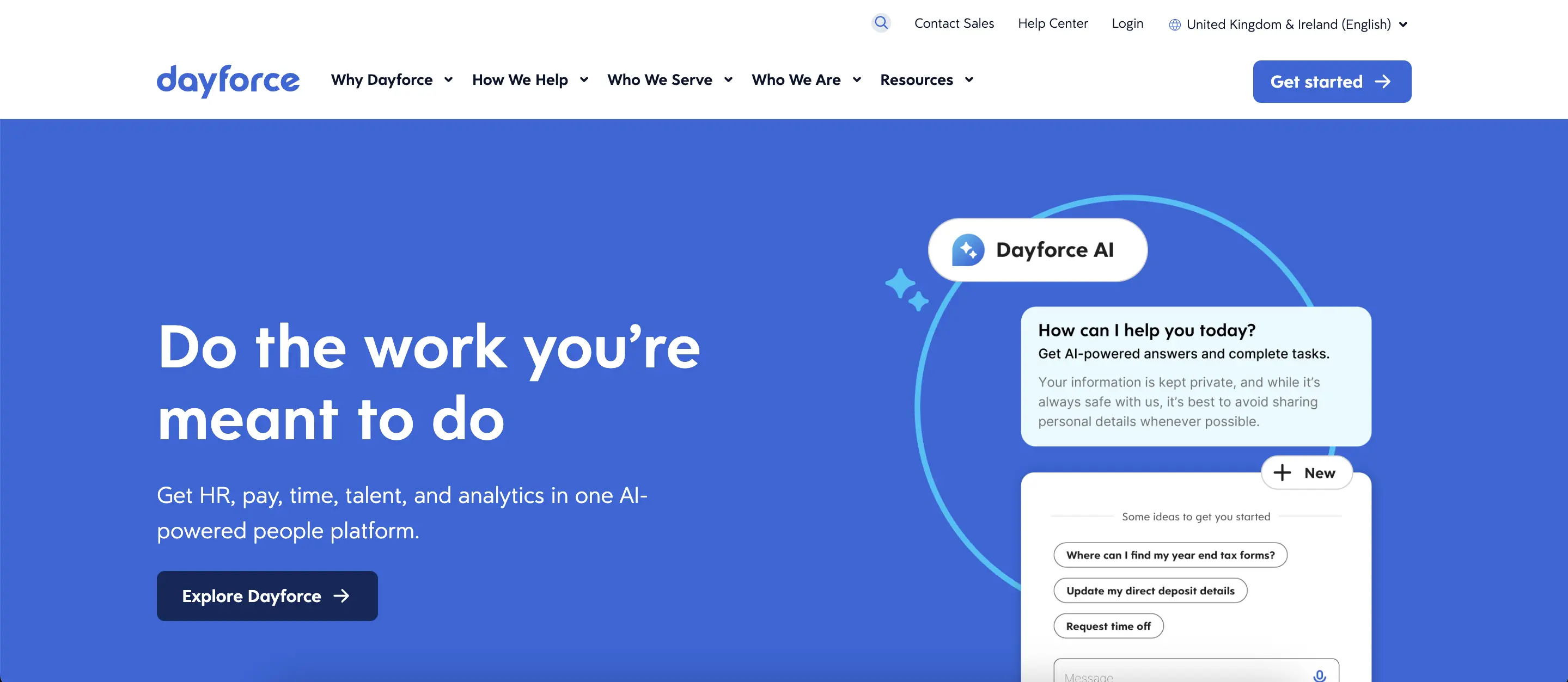
Dayforce is a cloud-based Human Capital Management platform built around a single, continuous calculation engine that updates payroll in real time rather than processing it in overnight batches. The company was taken private by Thoma Bravo in a deal that closed in February 2026. David Ossip remains the Chair and CEO throughout the transition.
Dayforce serves organizations in more than 50 countries, providing full payroll processing and claims compliance support that reaches over 200 countries overall.
Its single, unified data model, where one employee record supports payroll, scheduling, benefits, and talent management at the same time, remains its strongest technical advantage over competitors that piece together several acquired products.
Dayforce Features Review
Dayforce includes talent acquisition, workforce management, talent management, benefits, and a developing AI layer built on the same real-time data foundation. Below is my honest evaluation of each feature, highlighting what it does well and where it still has limitations:
Payroll & Continuous Calculation
Every approved timecard, rate change, or deduction updates gross pay immediately instead of waiting for an overnight batch run. This is the core idea behind Dayforce's continuous calculation engine.
This architecture directly addresses a specific problem: payroll surprises at the end of the period. Numbers remain current throughout the cycle instead of being accurate only after a batch job is completed.
Multiple pay groups, premium pay rules, and certified payroll support manage complex compensation structures. Tax filing updates occur automatically as regulations change across jurisdictions. This feature consistently receives the most praise from Dayforce reviewers, even those who are frustrated with other parts of the platform. It's also the reason a company chose Dayforce over a competitor in the first place.
Dayforce Wallet
Dayforce Wallet gives employees direct access to payroll. It allows them to access wages they've already earned before payday through an app or a linked prepaid card.
Since it uses the same continuous calculation data as payroll, an employee can't withdraw more than they've earned. Every on-demand transaction is automatically reconciled against the regular paycheck instead of creating a separate off-cycle payroll run.
Early data from Dayforce shows that Wallet adoption is linked to lower turnover. This is a strong retention argument for industries with high hourly and shift-based staffing. The feature costs employers nothing directly because it draws from wages already earned rather than extending credit.
I found that the Wallet is mainly focused on the U.S., Canada, and the UK. Companies must confirm which entities qualify before making broad promises.
Workforce Management & Scheduling
Time capture, shift scheduling, and labor forecasting all use the same real-time data as payroll. This means that any schedule change or approved overtime hour is reflected in cost projections immediately, rather than waiting for the next sync.
AI-optimized scheduling considers demand patterns and compliance rules together. Its goal is to reduce both overtime costs and the scheduling conflicts that can lead to turnover in shift-based roles.
Mobile clock-in with geofencing solves a specific, practical issue: it confirms that an employee actually clocked in from the correct location instead of relying on an honor system.
This module consistently receives praise from reviewers who manage frontline or shift-based teams. It highlights Dayforce's strong background as a workforce management specialist.
Talent Acquisition & Recruiting
Built-in applicant tracking covers job postings, pre-screening questions, and AI-assisted candidate scoring. The recruiting module can remove names, ages, and genders during early screening to help reduce a specific, identifiable source of bias.
Interview scheduling, assessments, and background checks all go through the same workflow instead of a separate system. Candidates can apply using just an email address or directly through Indeed Apply.
The ATS itself feels clunky, with recurring technical issues that are noticeable. Compared to dedicated ATS platforms, the matching and screening depth does not match what a specialized recruiting tool offers.
Additionally, Dayforce doesn't provide full-service recruitment or Employer of Record. Therefore, a company that is doing significant international hiring will likely need a separate tool for that aspect.
Talent Management & Learning
Performance reviews, succession planning, and compensation modeling all connect to the same employee record. This means that a promotion or a compensation change doesn't require re-entering data that already exists in the system.
Bench-strength assessments for succession planning are included by default, so there's no need for a separate module or consultant engagement.
Learning content, powered by the eloomi acquisition, now maps skills across the organization using AI-driven taxonomies that update as new content is added.
Personalized development paths suggest courses, mentors, or stretch assignments based on an employee's actual role and stated goals. This is a notably deep combination for a single platform. However, the effectiveness of the personalization depends on how consistently a company keeps its skills data current.
Dayforce AI Assistant & Agents
Dayforce's AI Assistant now works on both desktop and mobile. It answers straightforward questions about pay, benefits, and policy by using the employee's actual data instead of generic guidance. This conversational layer feels reliable enough for routine questions. What used to require a support ticket can now be answered directly.
The newer feature, called autonomous AI agents, aims much higher. It proactively identifies labor shortages before they lead to scheduling crises. It suggests shift changes on its own and even drafts recruitment ads based on what has historically worked for similar roles. The assistant that answers questions is proven and already in daily use.
However, the agents that make proactive staffing and hiring decisions are still new. I want to see a full year of customer results before I consider them mature.
Reporting & Analytics
More than 300 pre-built reports cover payroll, workforce, and compliance metrics right out of the box. Predictive analytics forecast labor costs and turnover risk using the same real-time data that powers every other module.
Dashboards update continuously instead of on a scheduled refresh. This is important for finance or HR leaders who need current numbers rather than yesterday's snapshot.
Custom reporting requires real configuration time before it becomes intuitive. The reporting interface feels more complex than necessary for straightforward requests.
However, once configured correctly, the depth of the reporting is a genuine strength. This is especially true for organizations that need to break down workforce cost data by location, department, or job family regularly.
Dayforce Pricing Review: Is It Worth the Investment?
Dayforce does not disclose pricing publicly. Each quote is tailored to employee count, selected modules, location, and implementation complexity, so obtaining one requires contacting Dayforce’s sales team.
Independent estimates suggest costs range from $100 to $500 per employee annually. Larger organizations often face higher per-user costs compared to competitors using tiered pricing.
Dayforce’s unified platform may offset some expenses by reducing the need for additional software. Implementations usually take 6 to 14 months, often involving partners like Deloitte or Accenture, with global rollouts taking longer.
Treat all figures as approximate, and request a detailed quote before comparing with competitors like Workday or UKG Pro.
Dayforce Marketplace
Dayforce Marketplace integrates with third-party benefits carriers, background check providers, and specialized workforce tools. The platform's single data model reduces the integration overhead that comes with syncing several disconnected systems.
Custom integrations and sandbox environments are priced separately from the base subscription, which matters for a company planning significant custom development work.
For organizations already using Dayforce's core modules, this integration layer works as expected with minimal friction. Companies evaluating Dayforce for its marketplace breadth, compared to platforms built around a large third-party app ecosystem, may find the selection narrower. Dayforce's strategy focuses on native functionality rather than an extensive partner network.
Dayforce Security and Compliance
Dayforce supports payroll compliance across multiple jurisdictions in the countries it serves. Tax and regulatory updates are applied automatically as requirements change, eliminating the need for manual monitoring. Configurable workflows help meet corporate governance needs for large, complex organizations that manage approval chains across various business units.
The AI-enhanced candidate screening in Recruiting removes names, ages, and genders during the early-stage review. This approach addresses a documented source of bias instead of relying on a vague fairness claim.
For companies with specific compliance needs that go beyond publicly available information, those discussions should be directed to Dayforce's sales and legal teams. The detailed certification scope varies by module and region.
Dayforce Reviews: Pros & Cons
Strengths of Dayforce
Based on my evaluation and cross-referencing verified user reviews, these are the standout strengths of Dayforce:
- Genuine Continuous Calculation Advantage: Users consistently credit real-time payroll processing with reducing period-end errors compared to platforms that still process overnight batches.
- Dayforce Wallet as a Retention Tool: Verified users in retail, hospitality, and healthcare specifically mention that on-demand pay access is a key factor that significantly aids hourly workforce retention.
- Strong Workforce Management for Shift-Based Teams: Users managing frontline or shift-based operations consistently praise scheduling, time capture, and labor forecasting as top-notch.
- Unified Data Model: Users frequently emphasize that they do not need to switch between systems, as payroll, workforce, and talent data all reside in one place and remain synchronized.
- Deep Reporting Once Configured: Verified users with technical setup experience describe the depth of analytics and forecasting as a true advantage over lighter competitors.
Limitations of Dayforce
Despite these strengths, the same users reported several cons of Dayforce that you should be aware of:
- Technical Instability in Recruiting: Multiple users reported the ATS as clunky with recurring technical issues, in contrast to how reliable the payroll and workforce modules feel.
- Irregular Release Cadence: Users note that updates don't always feel planned or predictable, which complicates change management for larger organizations.
- Complex Custom Reporting: Several users describe building anything beyond a standard report as more difficult than it should be without dedicated configuration expertise.
- Higher Per-User Cost at Scale: Users comparing Dayforce to competitors with tiered or modular pricing reported that per-employee pricing represented a real premium as an organization grows.
- Limited AI Matching Depth: Independent comparisons against specialized ATS platforms consistently flag Dayforce's candidate matching and high-volume screening as shallower than dedicated recruiting tools.
- No Talent Rediscovery of Past Candidates: Candidates who applied to a previous role and weren't hired don't automatically resurface for a new, similar opening.
How Integrating Skima AI Can Handle Dayforce's Limitations
Dayforce's recruiting tools rely on basic pre-screening logic rather than a specialized matching engine, and nothing in the platform rediscovers a past, qualified candidate automatically once a role closes. To address these Dayforce limitations, I noticed users often integrate Skima AI natively. Here is what the integration provides:
- Job Description Compliance Check: Before a requisition goes live, Skima AI flags language that may indicate gender or age bias. It audits inflated requirements that could indirectly exclude protected groups. It also confirms that a compensation range is included where local law requires it. This approach catches potential issues at the source, rather than after applications start arriving.
- AI Candidate Screening for New Applicants: As candidates apply for a job synced from Dayforce, Skima AI automatically screens and ranks each resume against the role's requirements. This allows a recruiter to view a prioritized shortlist instead of sorting through an unsorted queue of applications one by one.
- Talent Rediscovery for Past Candidates: Skima AI scans a company's existing Dayforce database for candidates who were previously screened but not hired. It surfaces qualified matches for a new opening without requiring a recruiter to start a new search from scratch.
- Explainable Match Scoring Behind Both: Every score includes a written explanation based on specific skills, years of experience, and certifications. This transparency allows a recruiter or hiring manager to understand exactly why a candidate received a particular ranking.
Who Is Dayforce Best For?
Dayforce is best for large, complex organizations with hourly or shift-based workforces that want real-time payroll accuracy and on-demand pay for retention. It suits those operating across multiple states or countries with intricate pay calculations.
Additionally, it benefits organizations with significant turnover and scheduling needs, while offering deep succession planning and skills-based learning within the same HR platform, typically for 1,000 or more employees.
Who Should Avoid Dayforce?
Dayforce's complex architecture may be excessive for simpler operations. Consider alternatives if you are a small or mid-sized company seeking a quicker HCM solution.
If you require advanced AI-driven candidate matching now, prefer clear pricing over custom quotes, or need integrated international recruiting support, it might not be the right fit. Additionally, if your hiring volume doesn't warrant a dedicated recruiting module, look elsewhere.
Final Verdict: Should You Buy Dayforce?
I'd recommend Dayforce for large, complex organizations, particularly those with hourly or shift-based staff. It offers true real-time payroll accuracy and treats on-demand pay as a critical retention tool. The continuous calculation engine is a genuine technical advantage, while Dayforce Wallet provides direct benefits to employees that competitors struggle to match.
Conversely, if a team needs advanced AI recruiting, transparent pricing, or a quicker implementation, I suggest exploring other options.
For those looking for explainable candidate scoring and automatic candidate rediscovery with their existing Dayforce setup, integrating Skima AI is a more feasible choice than waiting for Dayforce's recruiting module to evolve.
Dayforce Frequently Asked Questions
1. What is Dayforce?
Dayforce is Ceridian’s cloud-based human capital management HCM platform that combines payroll, HR, time and attendance, scheduling, benefits, and analytics into a single system for mid-to-large organizations.
2. Is Dayforce legit?
Yes, Dayforce is a reputable HCM solution used globally by thousands of enterprises, backed by Ceridian’s decades of HR/payroll experience, regulatory compliance support, and verified customer adoption.
3. How much does Dayforce cost?
Dayforce pricing is not publicly listed. Costs vary by selected modules, employee count, geographic complexity, and implementation services. Contact Ceridian sales for a tailored subscription quote and deployment estimate.
4. Is Dayforce suitable for small businesses?
Dayforce targets mid-to-large enterprises with complex payroll, compliance, and scheduling needs. Small businesses may find it costly and resource-intensive; evaluate simpler HCM/HRIS vendors if you have a limited budget or implementation capacity.
5. How long does Dayforce implementation take?
Implementation timelines vary substantially: simple deployments take several weeks, full enterprise rollouts often require several months. Duration depends on modules, integrations, data migration, and available internal or Ceridian professional services.
6. Can Dayforce integrate with Skima AI?
Yes, Dayforce integrates with recruiter-focused platforms like Skima AI via APIs. Skima AI enriches and scores candidates, automates outreach, and syncs recommendations back into Dayforce hiring workflows while preserving audit trails.