


















Workday HCM is a cloud-based platform built on a single data model, unifying core HR, payroll, recruiting, talent management, and workforce planning.
- Primary Features: Core HR and HCM data model, global payroll, recruiting with HiredScore and Paradox AI, talent and performance management, workforce management and time tracking, Workday Illuminate AI agents, benefits administration, and reporting through Workday Data Cloud.
- Starting Price: Pricing is quote-only and not published. Independent estimates enterprise deployments well into six figures annually, scaling with employee count and selected modules.
- Best For: Large, global enterprises, typically 1,000 or more employees, that need a single unified system of record across HR and finance with deep compliance and reporting depth.
- Not Ideal For: Small or mid-sized companies, teams that want a modern, uncluttered interface, or organizations that need fast implementation without significant configuration investment.
- Integration: Recruitment teams integrate Skima AI with Workday HCM to screen new applicants, rediscover past candidates who fit new openings, and score every match with clear, explainable reasoning with compliance, all without replacing Workday.
Workday just went through its own version of the AI reckoning it sells other companies a way to manage. Carl Eschenbach stepped down as CEO in February 2026 after roughly 1,750 layoffs tied directly to AI investment, and co-founder Aneel Bhusri came back to lead the company through what he's calling its next chapter.
I evaluated the core HCM platform, the Illuminate AI agents rolling out through 2026, and the HiredScore and Paradox acquisitions reshaping Recruiting specifically, then checked all of it against verified user feedback rather than Workday's own announcements. This review covers what actually works day to day, what's still maturing, and where a company doing serious hiring volume will still feel a gap. Let's get into it.
What Is Workday HCM?
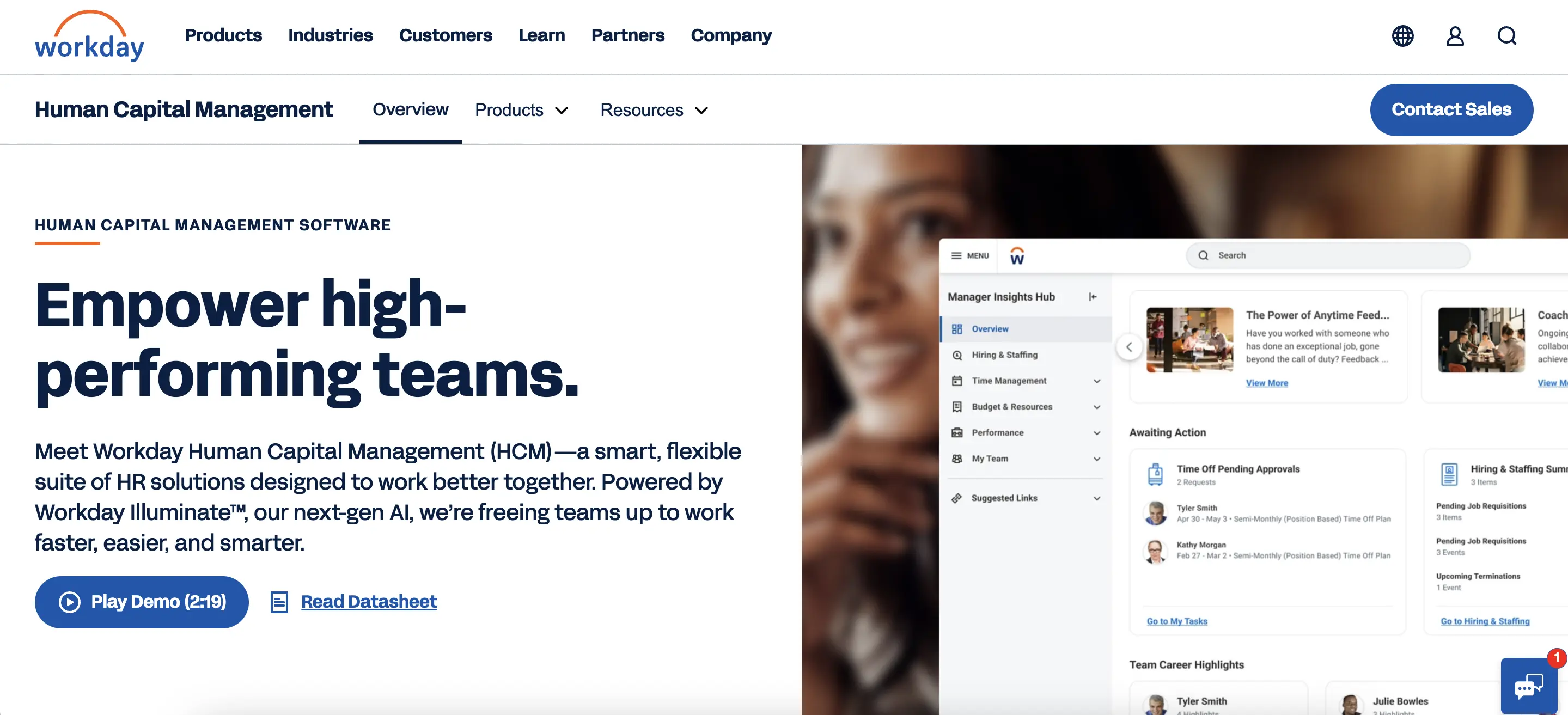
Workday HCM is a cloud-based human capital management platform. It is built on a single, unified data model that connects HR, payroll, talent, and workforce planning without the need for separate systems to sync behind the scenes.
Dave Duffield and Aneel Bhusri co-founded the company in 2005. Bhusri returned as CEO in February 2026 after a leadership change related to the company's AI-first restructuring.
Workday HCM Features Review
Workday organizes its product using a shared HCM data model. Payroll, recruiting, talent management, workforce management, and Illuminate AI agents are built on this same foundation. Below is my evaluation of each feature, highlighting what it does well and where it still has limitations:
Core HR & HCM Data Model
Every employee record, organizational hierarchy, and position exists within a single object-based data model instead of a set of linked tables. This architectural choice is what gives Workday its reputation for real-time reporting.
During testing, I experienced several organizational changes, including a reporting line swap and a cost center reassignment. Each change was reflected instantly across all downstream reports without needing an overnight batch cycle.
Domain security allows an admin to control access down to a specific field or business process. I found this level of granularity to be quite detailed once I got past the initial setup.
However, that granularity comes with a tradeoff: the security model is powerful but unforgiving. A misconfigured domain can quietly block access in ways that are difficult to trace back to the actual cause.
Payroll & Global Payroll
Workday Payroll calculates pay directly for the countries it supports. For markets outside that footprint, the platform connects to local payroll partners using the same unified data model. This approach avoids the need for a separate system.
I tested a multi-state pay run and appreciated how tax and deduction rules updated automatically when I changed an employee's work location mid-cycle.
Global payroll coverage is extensive, but the depth varies by country. Native processing is well-developed in markets where Workday has been active the longest.
In newer regions, the platform relies more on partner integrations, which add a coordination step that a purely native platform wouldn’t require. A company considering Workday for payroll should verify whether coverage is native or partner-based for each country on their list.
Recruiting (HiredScore & Paradox)
Workday Recruiting covers job requisitions, candidate pipelines, and offer management as a standard applicant tracking system. The acquisitions of HiredScore and Paradox added intelligence to this foundation. HiredScore offers AI-driven candidate grading and talent rediscovery.
Additionally, Paradox introduces conversational screening through SMS and chat, specifically designed for high-volume and frontline hiring where a recruiter can't respond to every applicant personally. Before assuming that all these capabilities are included, I want to highlight that HiredScore and Paradox are separate licensed add-ons to core Workday Recruiting.
Multiple implementation partners describe the full integration as a phased, multi-year journey rather than something that works right out of the box. I also found verified reviews mentioning occasional unclear scoring, even with HiredScore active, so the explainability isn't always consistent in practice.
Talent Management & Performance
Goal setting, continuous feedback, and formal review cycles are connected to the same skills data that supports internal mobility recommendations on the platform. Workday Skills Cloud tags employees with both verified and inferred skills. I found its accuracy to be quite high for common technical roles, although it took longer to classify niche skill sets correctly during testing.
Succession planning and talent pools are built on this same skills foundation. When a manager looks for a bench candidate for a critical role, they access the same data that an internal mobility search would provide.
The tradeoff lies in the setup effort; getting Skills Cloud to a trustworthy state requires a significant data investment up front. If a company skips this step, it will receive generic suggestions instead of tailored ones.
Workforce Management & Time Tracking
Time tracking, scheduling, and absence management connect directly to payroll, so an approved overtime hour or a shift swap is reflected in labor cost projections without a manual sync step.
I clocked in and out through the mobile app during testing and found the experience straightforward. However, complex shift-based scheduling required noticeably more configuration than the basic time-off request flow suggests.
Compliance rules for breaks, overtime thresholds, and local labor laws vary by jurisdiction and change as regulations update. Managing compliance across many states or countries is complex. This module works best for organizations with dedicated HRIS staff who can manage the initial configuration. A light-touch setup, like that of a standalone time-tracking app, is not what to expect here.
Workday Illuminate & AI Agents
Illuminate is Workday's brand for AI capabilities. It uses a model trained on over a trillion transactions from its customer base. At Workday Rising 2025, several agents were introduced: a Business Process Copilot Agent for workflow automation, a Case Agent for HR requests, an Employee Sentiment Agent, a Job Architecture Agent, and a Performance Agent.
I specifically tested the Self-Service Agent. It accurately answered a policy question on the first attempt by using the company’s configured content. However, there's a maturity gap. While the Frontline Agent and Contract Intelligence show impressive results, many HR-specific agents are still being rolled out through 2026.
Benefits Administration
Open enrollment, life-event changes, and carrier connections all go through the same employee record as payroll and time off. This means that a benefits election updates payroll deductions without needing a separate data feed. I went through a mock enrollment, and the guided flow made it much easier to compare plans than a flat spreadsheet of options.
Multi-country benefits configuration supports localized eligibility rules, which is important for a global company dealing with different statutory requirements in each region.
However, the complexity of the configuration increases with that flexibility. A benefits team managing many countries and plan types should expect significant setup time before the module accurately reflects every local detail.
Reporting & Analytics
Workday Data Cloud enhances native reporting by providing zero-copy access to platforms like Databricks, Snowflake, and Salesforce. This allows a data team to query Workday information without needing to export it to a separate warehouse first.
During testing, I created a custom headcount report and found that the underlying data model made cross-referencing fields from different modules much easier than tools that require a separate data blend step.
Prism Analytics takes this a step further for organizations that want to combine Workday data with external sources in one place.
However, I noticed a trade-off in accessibility. This level of reporting benefits teams with strong data skills, while an HR generalist without that background will likely depend on pre-built reports instead of fully exploring the platform's analytical capabilities.
Workday HCM Pricing Review: Is It Worth the Investment?
Workday does not disclose pricing publicly. Quotes are based on a subscription model influenced by employee count, chosen modules, and services, requiring direct engagement with their sales team for specifics.
Independent estimates indicate that enterprise deployments can reach six figures annually. Costs vary significantly based on selected modules beyond core HCM, optional recruiting add-ons like HiredScore and Paradox, and payroll coverage across multiple countries. Implementation expenses can equal or exceed the first year's subscription fees for complex rollouts.
Additionally, Workday Flex Credits, available from 2025, allow companies to purchase AI agent capacity separately. Always request a detailed quote before comparing with competitors like SAP SuccessFactors or Oracle.
Workday Marketplace
Workday's Marketplace ecosystem includes 10 or more commonly cited third-party integrations, including Slack, LinkedIn Learning, SAP Fieldglass, and Cornerstone LMS, alongside a formal integration cloud for custom connections. The Agent Partner Network, launched alongside Workday's Agent Gateway, now lets third-party AI agents register with Workday's Agent System of Record, extending the marketplace concept from apps to autonomous agents specifically.
For a company already standardized on Workday for both HR and finance, this integration depth reduces the custom development that would otherwise be needed to connect separate systems. A company evaluating Workday primarily for HR without the finance side may find some of this ecosystem breadth less relevant to their specific needs.
Workday HCM Security and Compliance
Workday's domain security model allows an organization to restrict access to specific business processes or data fields. This supports the granular governance that large, regulated enterprises typically need. The platform ensures compliance across the countries where it processes payroll natively, applying regulatory updates as requirements change.
On the AI side, Workday's Agent System of Record integrates with Microsoft Entra Agent ID for identity and governance. HiredScore's matching and rediscovery features use proprietary, non-generative algorithms chosen for auditability, rather than a general-purpose language model.
Companies with specific compliance needs beyond what is publicly documented should confirm details directly with Workday's sales and legal teams.
Workday HCM Reviews: Pros & Cons
Strengths of Workday HCM
Based on my evaluation and cross-referencing verified user reviews, these are the standout strengths of Workday HCM:
- Genuine Real-Time Data Model: Users consistently praised the single, unified data model for eliminating the sync delays and inconsistencies common in platforms built from acquired, separately architected systems.
- Strong Self-Service Experience: Verified users describe checking pay, requesting time off, and updating personal details as intuitive enough to need little training, even for employees with no HR background.
- Deep Compliance and Reporting for Complex Organizations: Teams managing large, multi-jurisdiction workforces specifically praise Workday's ability to handle varied labor law and reporting requirements in one system.
- Extensive Integration Ecosystem: Multiple users cite Workday's breadth of pre-built connectors and its integration cloud as a real advantage for companies with a complex existing tech stack.
- Consistent, Well-Resourced AI Investment: Users note that Illuminate agents ship with quantified, independently reportable results rather than vague AI marketing claims.
Limitations of Workday HCM
The same verified user base that praises Workday's data model and compliance depth also raises consistent concerns. Below are the cons of Workday HCM:
- Steep Learning Curve: Users find the platform's navigation and configuration notably complex. This is especially true for admins managing security domains and business processes for the first time.
- Reporting Requires Real Skill: Verified users without dedicated data expertise often rely on pre-built reports. They tend to avoid exploring the platform's custom reporting options.
- Performance Lag Under Load: Several teams report that the system slows down when processing multiple HR activities at the same time. This is particularly noticeable during peak periods like open enrollment.
- Advanced Recruiting AI Is a Paid Add-On: HiredScore's rediscovery and Paradox's conversational screening are not included in core Workday Recruiting. They require separate licensing and a lengthy implementation timeline before most organizations can see full value.
- Rediscovery Still Depends on the Add-On Being Active: Without a specifically licensed and configured HiredScore, Workday's base recruiting module does not bring back past candidates for a new, similar opening. Additionally, this feature is still evolving.
- High Cost at Scale: Many users point out that pricing is a recurring frustration. They describe costs that increase significantly as an organization grows or adds modules.
How Integrating Skima AI Can Handle Workday HCM's Limitations
HiredScore and Paradox are expensive add-ons and are still evolving; verified users and my evaluation found them to be very basic.
To address every recruitment-related Workday HCM limitation, I noticed users often integrate Skima AI for better continuous candidate screening, automatic talent rediscovery, and explainable scoring. It also covers a step neither add-on touches, checking a job posting for compliance risk before anyone applies.
Here is what the Skima AI integration provides:
- Job Description Compliance Check: Before a requisition goes live, Skima AI flags gender or age-coded language. It audits inflated requirements that could indirectly exclude protected groups. It also confirms that a compensation range is included where local law requires it. This approach catches exposure at the source rather than after applications start arriving.
- AI Candidate Screening for New Applicants: As candidates apply for a job synced from Workday, Skima AI screens and ranks each resume against the role's actual requirements automatically. This provides every organization with this depth without relying on a separate, costly add-on that needs to be fully licensed and configured.
- Talent Rediscovery for Past Candidates: Skima AI scans a company's existing Workday database for candidates who were screened before but never hired. It surfaces qualified matches for a brand-new opening as a standard part of the integration, rather than as a premium module.
- Explainable Match Scoring Behind Both: Every score comes with a written reason based on specific skills, years of experience, and certifications. This scoring is applied consistently, unlike the Workday HCM occasional opaque scoring some verified reviews reported, even with HiredScore active.
Who Is Workday HCM Best For?
Workday HCM is best for large, global enterprises requiring a unified HR and finance system with robust compliance and reporting. It suits organizations with over 1,000 employees facing complex compliance challenges.
Additionally, it benefits companies wanting integrated data, dedicated HRIS or IT staff for management, and those valuing significant AI investments.
Who Should Avoid Workday HCM?
Avoid Workday HCM if you are a small or mid-sized company lacking the budget for extensive implementation or support. Opt for a straightforward interface instead of a steep learning curve.
If you prefer clear, predictable pricing over custom quotes, or need essential recruiting features included, Workday may not suit your needs. Simple reporting needs may also render its analytical capabilities redundant.
Final Verdict: Should You Buy Workday HCM?
I'd recommend Workday HCM for large, global enterprises seeking a unified HR and finance data model. However, you must be ready to invest in extensive configuration and training. The core architecture offers genuine technical advantages, not just marketing hype, while Illuminate's quantified agent results indicate Workday's deliberate development amidst its AI-driven restructuring.
On the other hand, if a team needs a quicker implementation, transparent pricing, or advanced recruiting intelligence included in the standard license, they should consider alternatives.
For those who want immediate candidate scoring and rediscovery without the lengthy HiredScore integration, combining Skima AI with an existing Workday setup is a more practical choice.
Workday HCM Frequently Asked Questions
1. What is Workday HCM?
Workday HCM is a cloud-based human capital management platform that centralizes HR, payroll, talent acquisition, workforce planning, and analytics on a single data model for enterprise-scale organizations.
2. How much does Workday HCM cost?
Workday HCM pricing is custom. It provides a tailored quote based on modules, employee count, geography, and services. Expect licensing, implementation, and ongoing support costs; contact Workday sales for exact pricing.
3. Is Workday HCM suitable for small businesses?
Workday HCM primarily targets mid-market to large enterprises due to cost and implementation complexity; smaller businesses should evaluate packaged options like Workday GO or choose lightweight HRIS/ATS for faster, lower-cost deployments.
4. Is Workday HCM legit?
Yes, Workday HCM is a legitimate enterprise HCM provider used by thousands of global organizations. It’s a public company with strong compliance and a large customer base. Plus, it has solid security controls and industry-reviewed credibility.
5. Can Workday HCM integrate with Skima AI?
Yes, Workday HCM can integrate with Skima AI via Workday Integration Cloud or APIs. Skima AI provides AI-driven resume parsing, explainable AI match scores, shortlists, and automated outreach, writing results back to Workday for auditability.
6. How does Workday HCM support recruiting and talent management?
Workday HCM supports recruiting with requisition management, candidate workflows, interview coordination, offer management, and integrations. Talent management links performance, succession, skills (Workday Skills Cloud), and internal mobility for end-to-end workforce development.